Don't miss our holiday offer - up to 50% OFF!

Custom denim jeans manufacturer

In the ever-evolving world of fashion, denim remains an undisputed cornerstone of global apparel. From its humble beginnings as workwear for miners and railroad workers in the 19th century to its current status as a high-fashion staple, denim has demonstrated remarkable resilience and adaptability -8. Today, the global denim market continues to expand, driven by constant innovation in fits, finishes, and sustainability practices -3. For fashion brands looking to make their mark in this competitive landscape, partnering with the right custom denim jeans manufacturer is not merely a supply chain decision—it is a strategic choice that determines product quality, brand identity, and long-term market success.
This comprehensive guide explores every facet of custom denim jeans manufacturing, providing brand owners, designers, and entrepreneurs with the technical knowledge and practical insights needed to navigate the complex journey from concept to finished product. At the conclusion, we introduce ZENITH CLOTHING, a premier garment manufacturing partner committed to excellence in denim production.
Understanding Custom Denim Manufacturing
Defining Custom Denim Production
Custom denim manufacturing refers to the process of creating jeans according to a brand’s specific design requirements, fit preferences, and quality standards -7. Unlike off-the-shelf products, custom denim involves a collaborative relationship between the brand and the manufacturer, resulting in exclusive styles that reflect the brand’s unique vision and market positioning.
The distinction between OEM (Original Equipment Manufacturer) and ODM (Original Design Manufacturer) partnerships is crucial for brands to understand -7. In an OEM arrangement, the brand provides complete design specifications, including tech packs, patterns, and measurements, and the manufacturer executes these exact requirements. This model offers maximum design control and intellectual property protection. In contrast, an ODM partnership involves the manufacturer contributing design elements, such as proprietary patterns, washes, or fabric innovations. While ODM arrangements typically offer faster turnaround times and lower upfront costs, they may involve shared design rights -7.
The Importance of Specialized Denim Manufacturing
Denim production differs significantly from manufacturing other garment categories. As industry experts note, jeans involve more variables than T-shirts or woven tops, including fabric shrinkage after washing, stretch recovery loss over time, wash effects on size and shape, and construction stress points at the waistband, hips, and knees. These complexities require manufacturers with specialized expertise in denim construction, washing techniques, and quality control.
A professional custom denim manufacturer approaches development with appropriate caution, recognizing that decisions made during fabric selection affect pattern behavior, pattern adjustments affect washing results, and washing results affect final fit and measurement tolerance. This interconnectedness demands a manufacturing partner who understands the complete production ecosystem.
The Custom Denim Manufacturing Process
Stage 1: Design Development and Technical Translation
Every successful denim project begins with a clear design concept. Brands typically provide design sketches, reference photos, vintage samples, or competitor products as starting points. However, these materials are not production documents. The first task of a professional manufacturer is to translate design intent into technical language that guides the entire production process.
This translation includes defining fit direction—whether straight, relaxed, tapered, wide, or slim—determining rise type (high, mid, or low), identifying the target wearer demographic, and specifying fabric weight range and stretch requirements. This stage is where many misunderstandings can begin, as subjective terms like “slightly loose” or “vintage fit” can carry different meanings for different teams. An experienced manufacturer will not move directly to sampling but will instead clarify what can realistically be produced and worn.
Stage 2: Pattern Development and Grading
Pattern development forms the foundation of fit for custom jeans. Unlike copying existing sizes or scaling basic blocks, custom patterns define the entire product experience. Professional pattern development considers waist-to-hip ratios, thigh and knee balance, front and back rise length, and leg opening proportions based on the target body shape and market, not generic templates.
Size logic confirmation is equally critical. Before grading begins, brands must clarify size range structure, whether plus sizes require independent pattern logic, and how consistent the fit should feel across sizes. Many bulk production issues trace back to unclear sizing logic rather than sewing quality, making this stage essential for long-term success.
Leading brands often employ specialized pattern makers who work full-time on fits and sizing, recognizing that this expertise makes a significant difference in final product quality.
Stage 3: Fabric Selection and Sourcing
Fabric selection is arguably the most consequential decision in custom denim production. The choice is rarely about “better” or “worse” but rather whether the fabric works with the intended design and production process. Professional manufacturers evaluate fabric weight suitability for the pattern, weave density and shrinkage risk, stretch yarn percentage and recovery, and compatibility with washing techniques.
Denim fabrics range from rigid 100% cotton to stretch blends containing elastane, each offering distinct benefits. Rigid 100% cotton denim, typically weighing 10–14 ounces per square yard, delivers vintage authenticity and structure. Cotton-elastane blends, with common ratios of 98/2 or 97/3, provide 20–30 percent elongation with excellent recovery, making them ideal for skinny styles and comfort-focused cuts. Performance blends incorporating polyester offer additional benefits such as UV resistance and wrinkle control.
Sustainability considerations increasingly influence fabric selection, with organic cotton, recycled fibers, and low-impact dyes gaining prominence. Certifications such as GOTS, OEKO-TEX, and Bluesign provide assurance that fabrics meet high ethical and environmental standards.
Stage 4: Wash and Finish Planning
In denim manufacturing, washing is not merely a final decoration step but an integral part of the production design. During development, wash plans typically define pre-shrink methods, enzyme or stone abrasion intensity, manual versus machine-controlled effects, and expected size changes after washing.
The range of wash treatments available to custom denim brands is extensive. Enzyme washes create softness and subtle fading, stone washing with pumice stones produces vintage character, and laser technology enables precise distressing with reduced water and chemical usage. Advanced techniques such as ozone washing and e-flow technology further minimize environmental impact while achieving desired aesthetic effects.
A critical reality in denim production is that samples can be manually adjusted, but bulk production cannot. Reliable manufacturers avoid wash effects that cannot be repeated at scale, focusing on control rather than creativity alone.
Stage 5: Sampling and Fit Approval
Sample development is a process, not a one-time event in custom denim production. Industry practice typically involves multiple sample rounds, with first samples confirming direction and construction, second samples adjusting fit and wash, and third samples finalizing details and size verification. Each sample stage reduces future risk, and manufacturers who promise one sample to bulk often push unresolved issues into production.
Digital tools are increasingly transforming this stage, with 3D prototyping software enabling virtual fit sessions and reducing sampling rounds by up to 30 percent. However, physical samples remain essential for evaluating fabric hand feel, wash appearance, and actual garment drape.
Stage 6: Bulk Production Planning
Sample approval does not automatically mean bulk production begins. Before production, manufacturers typically finalize grading and size specifications, technical construction sheets, fabric and trim inspections, and wash parameter locking. The goal is to remove personal judgment and rely on repeatable procedures—a key differentiator between experienced manufacturers and smaller workshops.
Fabric arrives at the factory on large rolls and must first “relax” through unrolling and airing to prevent shrinkage and distortion during cutting. Each roll may differ slightly in color, yarn characteristics, or shrinkage percentages, requiring careful inspection before production commences.
Stage 7: Cutting and Sewing Operations
Bulk denim production follows systematic stages designed for consistency and efficiency. Cutting operations incorporate shrinkage allowances based on fabric testing, with marker planning minimizing waste—typically 5–8 yards per dozen pairs.
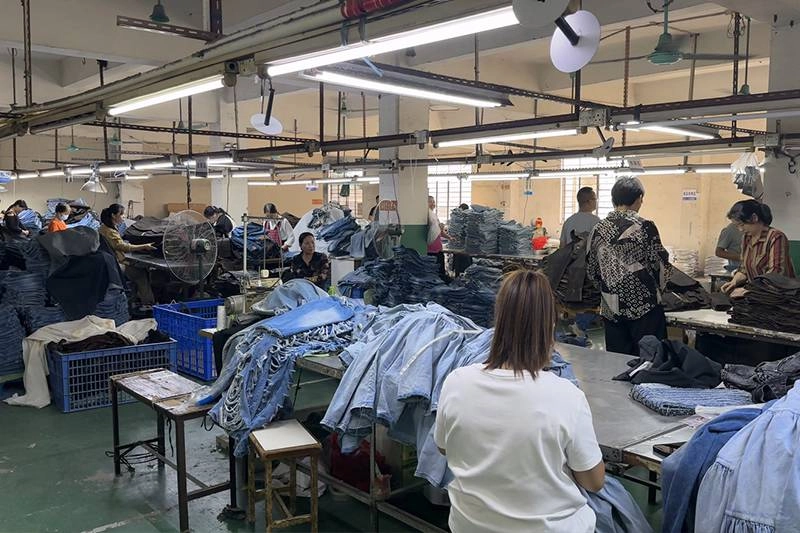
Each pair of jeans consists of multiple precisely cut pieces—pockets, leg panels, waistbands, and belt loops—that are assembled by specialized workers. In larger factories, the process is divided into efficient workflows with operators focusing on specific operations such as pocket attachment, fly construction, or waistband installation.
Construction quality is monitored through metrics such as stitch density (typically 8 stitches per inch) and seam integrity, ensuring that every pair meets established standards -7.
Stage 8: Washing and Finishing
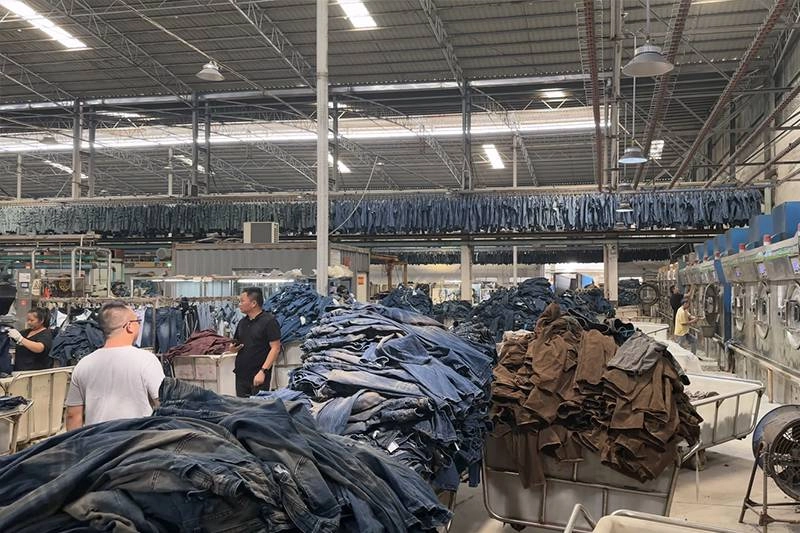
Following sewing, jeans undergo dry processes such as hand sanding or laser distressing to create wear patterns, followed by wet processing through specialized washing equipment. Modern washing facilities increasingly incorporate water recycling systems that reduce consumption dramatically—from historical levels of up to 7,000 liters per pair to current systems where water is treated and reused in subsequent production cycles.
Finishing touches, including labels, rivets, buttons, and leather or jacron patches, are applied after washing to prevent damage during processing. The final shaping and pressing ensure that jeans present properly for packaging and retail display.
Stage 9: Quality Control and Inspection
Final inspection in professional denim manufacturing focuses on wearability rather than perfection. Quality control examines measurement tolerance, wash consistency, natural drape when worn, and structural integrity after finishing. For brands selling internationally, this step directly affects return rates, customer feedback, and long-term brand trust.
Common quality metrics include dimensional tolerance of plus or minus one centimeter, colorfastness ratings of at least 4 on standard scales, and thorough examination of stitch quality and hardware attachment.
Quality Control Throughout the Manufacturing Process
Raw Material Inspection
Quality control begins before production with comprehensive raw material testing. Yarn tensile testing ensures minimum tenacity standards, fabric shade approval uses spectrophotometers to verify color accuracy against lab dips, and defect rates are monitored to maintain acceptable quality levels -7.
In-Process Production Checks
Throughout cutting and sewing operations, quality control personnel monitor production lines, conducting regular inspections to identify issues before they compound. This proactive approach addresses problems at their source rather than relying solely on final inspection to catch defects.
Final Garment Audits
The final quality control stage involves statistical sampling of finished products according to international standards. Trained inspectors evaluate garments against approved samples and specification sheets, ensuring that bulk production accurately reflects approved prototypes.
Sustainability in Modern Denim Manufacturing
Environmental Challenges and Innovations
Traditional denim manufacturing has faced criticism for environmental impacts including high water consumption, chemical usage, and wastewater discharge. However, the industry has responded with significant innovations that reduce environmental footprints while maintaining product quality.
Advanced denim technologies now use less water, energy, and carbon emissions to dye fabric than traditional processes. Compared to conventional denim sheet dyeing, advanced methods consume 25 percent less CO2 emissions and typically 80 percent less water. Technologies such as laser finishing, foam dyeing, and ozone processing enable sustainable production without compromising aesthetic possibilities.
Certifications and Standards
Brands seeking verified sustainable production should look for manufacturers holding recognized certifications. GOTS (Global Organic Textile Standard) ensures organic fiber content and responsible manufacturing practices. OEKO-TEX certification verifies that products are free from harmful substances. Bluesign certification addresses comprehensive environmental, health, and safety standards throughout the supply chain.
Common Challenges in Custom Denim Production
Fit Consistency Across Sizes
Maintaining consistent fit across size ranges presents significant challenges in denim manufacturing. Plus sizes may require independent pattern logic rather than simple scaling, and proportional relationships between measurements must be carefully managed to ensure that all sizes deliver the intended wearing experience.
Wash Repeatability
Creating consistent wash effects across production batches requires precise process control and thorough documentation. Manufacturers must balance creative washing objectives with the practical reality of mass production, selecting techniques that can be reliably reproduced at scale.
Fabric Variation Management
Natural variations in fabric characteristics—whether in dye shade, shrinkage behavior, or stretch recovery—require active management throughout production. Professional manufacturers test incoming fabrics and adjust processes accordingly, rather than assuming consistency across rolls.
ZENITH CLOTHING: Your Premier Custom Denim Manufacturing Partner
Having explored the complexities and requirements of professional denim manufacturing, we proudly introduce ZENITH CLOTHING as your trusted partner in custom denim production.
Who We Are
ZENITH CLOTHING stands at the forefront of garment manufacturing, combining decades of industry expertise with state-of-the-art production facilities. We specialize in creating premium custom denim jeans that meet the exacting standards of fashion brands worldwide. Our commitment to quality, innovation, and sustainability makes us the ideal partner for brands seeking to establish or expand their denim offerings.
Our Manufacturing Philosophy
At ZENITH CLOTHING, we understand that successful denim production is not about perfection but about making informed decisions at the right time. We approach every project with a focus on process clarity, recognizing that understanding the manufacturing process helps brands make better choices earlier—when changes are manageable and costs remain under control.
Our Capabilities
Comprehensive Pattern Development: Our technical team creates precise patterns based on your design specifications, ensuring that fit intentions translate accurately into finished products. We manage the complete grading process with attention to size consistency across your entire range.
Expert Fabric Sourcing: We maintain relationships with premium denim mills worldwide, offering access to a wide range of fabrics from rigid heritage denim to advanced performance blends. Our team guides you through fabric selection based on your design goals, target market, and production requirements.
Advanced Washing Facilities: Our washing department utilizes the latest technologies to achieve your desired aesthetic while maintaining environmental responsibility. From classic stone washes to precise laser effects, we deliver consistent results across production batches.
Rigorous Quality Control: Every pair of jeans bearing your brand receives thorough inspection against your specifications and approved samples. Our quality systems address every stage of production, not just final inspection.
Our Commitment to Sustainability
ZENITH CLOTHING embraces sustainable manufacturing practices that minimize environmental impact without compromising quality. We invest in water-efficient technologies, monitor our energy usage, and partner with fabric suppliers who share our commitment to responsible production. We believe that better denim starts with better practices.
Partnership Approach
We view every brand relationship as a partnership rather than a transaction. Whether you are launching your first denim collection, switching suppliers, or scaling from sampling to larger orders, our team provides the technical expertise and production support you need -10. We help you avoid common production mistakes, set realistic timelines, and make informed decisions that protect your brand reputation.
Conclusion
Custom denim jeans manufacturing represents a sophisticated intersection of design vision, technical expertise, and production discipline. Success requires understanding the complete manufacturing process—from initial concept through pattern development, fabric selection, washing, and quality control. Brands that master this knowledge, whether through internal expertise or trusted manufacturing partners, position themselves for long-term success in the competitive denim market.
At ZENITH CLOTHING, we combine manufacturing excellence with partnership commitment, delivering custom denim that meets your specifications and exceeds your expectations. We invite you to experience the difference that professional manufacturing makes—where your brand vision becomes reality, and quality is assured at every step.
Contact ZENITH CLOTHING today to discuss your custom denim project. Together, we will create jeans that your customers will love and your brand will be proud to offer.