Don't miss our holiday offer - up to 50% OFF!

Custom Streetwear Denim Shorts & Jeans | Low‑MOQ OEM Streetwear Production

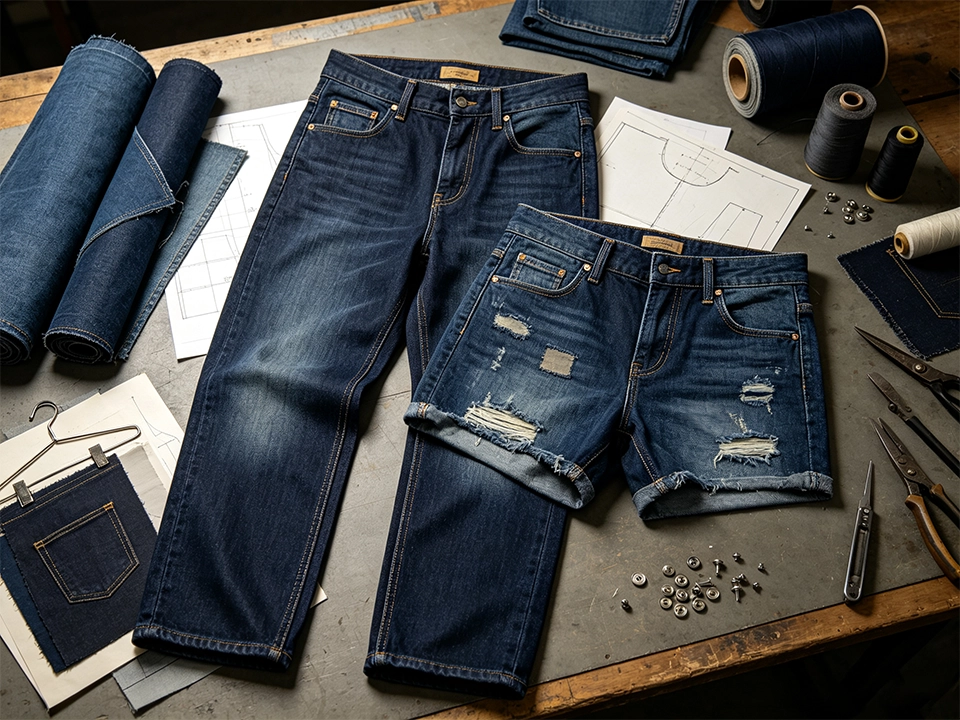
Streetwear denim has long transcended basic casual wear to become a core carrier of youth subculture, personalized expression, and trendy brand aesthetics. Among all denim styles, custom distressed streetwear denim — including iconic street-style denim jeans and versatile denim shorts — stands out for its unique vintage worn texture, diverse personalized details, and inclusive street styling. For emerging streetwear labels, boutique fashion brands, and wholesale apparel businesses worldwide, professional low-MOQ OEM cut-sew denim apparel manufacturing services have become the key to turning creative denim concepts into market-leading, high-quality wearable products.
1. Introduction: The New Rules of Streetwear Production
Let’s cut through the noise. For years, launching a custom denim line was a game reserved for the well-capitalized—those willing to sink thousands into inventory before a single pair had even been sold. The traditional model demanded a minimum of 2,000 to 5,000 pieces per style, which, for a startup, was less a business strategy and more a recipe for financial ruin . But the landscape has shifted. The rise of low-MOQ OEM streetwear production has democratized the industry, empowering a new generation of founders to bring their vision to life. Today, it is possible to test a collection of custom streetwear denim shorts and jeans with an entry point that is not only realistic but prudent.
2. Why Low MOQ Matters for Emerging Brands
Why is this so important? The answer lies in agility. A lower MOQ is an investment in risk mitigation. It means you can test a design, a wash, or a silhouette with your audience without committing to thousands of units that might languish in a warehouse . By ordering what you can realistically sell, you maintain healthy cash flow and gain the freedom to iterate based on real market feedback. This ability to pivot is essential in the fast-paced world of streetwear culture where today’s must-have silhouette could be tomorrow’s afterthought.
3. What Is a Realistic Low MOQ in 2026?
The definition of “low” has become surprisingly flexible. Traditional factories might still demand massive orders, but a new breed of manufacturer is catering to the modern brand. A realistic low MOQ for fully custom, factory-made denim is typically in the range of 30 to 200 pieces per style and wash . Some innovative suppliers are even willing to work with a starting point of just 20 pieces for a single design . It is crucial to distinguish between genuine production and white-labeling; if a factory promises to make you 10 custom washed jackets, they are likely either hand-washing them, which ruins consistency, or buying pre-made stock and adding your label .
4. Mixing Sizes Without Panic: The Flexible Size Run
One of the most significant innovations in low-MOQ production is the shift away from per-size MOQs. In the old model, a “20-piece minimum” might mean ordering 20 smalls, 20 mediums, and 20 larges, effectively a 60-piece MOQ. The new model is far more rational. The MOQ now applies to the total order, not each individual size . This allows for a flexible size distribution that mirrors real-world demand. For a 20-piece order, a typical breakdown might be 2 pieces in size 28, 5 in size 30, 6 in size 32, 5 in size 34, and 2 in size 36 . This lets you allocate more units to the sizes your audience is likely to wear.
5. Multi-Wash Flexibility: Testing the Waters
The same logic applies to washes. Do you want to test a stone wash against an acid wash? You no longer need to choose just one. The right low-MOQ partner can split a small batch across multiple wash treatments . For instance, an order of 20 pieces could be divided into 5 pieces in a classic stone wash, 5 in a retro acid wash, 5 in an eco-friendly ozone wash, and 5 raw . This capability is a game-changer for trend-driven brands looking to gauge what resonates with their community without committing an entire run to a single finish.
6. Beyond Washes: Mixing Colorways on Small Runs
Can you do 5 colorways across a 20-piece order? Yes, provided each colorway gets a small allocation, typically a minimum of 4-5 pieces to maintain dye consistency . A smart strategy for a small batch is to designate 8 pieces for your “hero” colorway—the classic indigo, for example—6 pieces for a secondary option, and a few pieces each for two or three “wild card” colors . This approach yields valuable market data on color preferences without requiring massive investment in any single direction.
7. Custom Hardware on Low-MOQ Orders: The Smart Strategy
Custom-engraved buttons and rivets add a professional finish that screams “premium brand.” However, hardware suppliers often have their own MOQs, typically in the range of 1,000 pieces . This seems like a major hurdle for a 100-piece order. The solution is elegant: order the 1,000-piece minimum, use what you need for the current production run, and have the manufacturer warehouse the remaining stock for your subsequent reorders . This strategy allows you to have your custom hardware without the burden of storing it yourself.
8. Product Types: From Jorts to Jackets
When we talk about low-MOQ streetwear denim, the scope is broad. The most popular categories include baggy jeans, wide-leg jeans, straight-leg jeans, and the ever-popular denim shorts, or jorts . The product range typically extends to denim jackets, workwear-inspired carpenter jeans, and even full capsule collections . The key is that many manufacturers allow you to mix different product types within a single order—for example, 10 jeans and 10 jackets to reach your MOQ—though this is often considered on a case-by-case basis .
9. The Sampling Phase: What to Expect
Before any bulk production begins, there is the crucial sampling phase. This is where your vision is translated into a tangible prototype. Most manufacturers will create a Pre-Production (PP) sample that matches your chosen fabric, wash effect, and distressing details. This sample is typically ready in 7 to 15 working days . Sampling allows you to evaluate the workmanship, fit, and overall feel before committing to the full run. It is a safeguard against expensive errors and ensures the final product aligns with your brand’s standards.
10. Production Timelines and Lead Times
Patience is a virtue in manufacturing. The timeline from sample approval to shipment requires careful planning. Generally, bulk production takes 20 to 35 days after the sample is approved and the deposit is confirmed . When planning a product drop, it is advisable to budget for about six to eight weeks from sample approval to delivery, factoring in shipping and customs . Factors like fabric availability and wash complexity can extend this timeline, so communication with your partner is key.
11. Quality Control at Any Order Size
One of the greatest fears for a new brand is inconsistency—receiving a batch where the distressed detailing looks haphazard or the wash doesn’t match. A reputable low-MOQ manufacturer maintains the same rigorous quality control (QC) standards regardless of order size . This includes inline inspections during production, followed by final AQL batch checks. Certifications like CE, ISO, BSCI, and REACH indicate a commitment to quality and safety that extends to even the smallest orders . Your 20-piece order should pass the same criteria as a 2,000-piece order.
12. Private Label Branding: Making It Yours
Custom production is about more than just the fabric and fit; it is about creating a brand experience. A true OEM partner offers a full suite of private label services. This includes custom woven labels, jacron patches, branded hangtags, and custom hardware . Even the packaging can be customized to enhance the unboxing experience. These small details differentiate a genuine brand from someone selling generic stock.
13. Amazon FBA and Packaging Compliance
For e-commerce sellers, particularly those using Amazon FBA, packaging compliance is non-negotiable. A knowledgeable manufacturer can handle this for you. They apply FNSKU barcodes, ensure individual polybags meet size and suffocation warning requirements, and prepare cartons to Amazon’s strict dimensional and weight limits . This service saves you the headache of preparing inventory yourself and helps ensure your products are accepted at the fulfillment center .
14. Streetwear Silhouettes That Sell
The “cut” of your denim is the central pillar of its identity. For streetwear, the most sought-after silhouettes are the baggy, wide-leg, and relaxed fits . These styles are not only on-trend but also provide an ideal canvas for heavy distressing. A relaxed fit reduces tension on ripped areas, preventing premature failure . Whether you are producing carpenter pants, cargo jorts, or classic baggy jeans, the fit is what will define your brand’s signature.
15. Understanding Cost Per Unit (CPU) with Low MOQ
A lower MOQ directly increases your Cost Per Unit because the fixed factory setup costs—pattern making, wash testing, machine calibration—are distributed across fewer garments . While the per-item price at 100 pieces will be higher than at 5,000 pieces, paying a few dollars more per garment is a small price to pay for avoiding inventory suicide. It is a strategic investment in de-risking your business .
16. The Development Process for First-Time Brands
For many first-time founders, the concept of a tech pack is foreign. The best low-MOQ partners understand this and offer development support beyond just production. They can start with reference photos, rough sketches, or a mood board and help you identify what is needed to move toward sampling . They guide you through simplifying complex details for a first launch and help you build a product that can be scaled later if it performs well . This mentorship is invaluable for emerging brands.
17. Why a Denim-Focused Manufacturer Matters
Not all apparel factories are created equal. Denim is a specialized material that requires specific machinery and expertise, particularly for washing and distressing. A denim-focused manufacturer understands fabric behavior, shrinkage, and the nuances of wash development . They are not just cutting and sewing; they are engineering a product. Working with a partner who understands streetwear culture—the meaning behind a specific wash or the social cue of a baggy fit—makes for a fundamentally different, and better, conversation .
18. Scaling from Test Run to Full Production
The goal of a first order should not be simply “to get something made.” It is to build a foundation for a long-term brand . The production process, measurements, fit, and wash recipes established during the initial low-MOQ run are documented and can be repeated. If the market response is strong, you can confidently place a larger reorder, knowing exactly what the final product will look like. This is how you grow from testing the waters to commanding a significant share of the streetwear market.
19. Conclusion: Start Small, Think Big
The barriers to entry in streetwear have effectively been dismantled. Low-MOQ OEM production has made it possible for any brand with a vision to produce high-quality, custom denim without the burden of massive inventory. By embracing flexibility in sizing, washes, and hardware, you can test the market, learn what your community loves, and build a brand with genuine identity. Start small, think big, and let the quality of your custom pieces do the talking. The future of streetwear is not just denim; it is your denim.