Don't miss our holiday offer - up to 50% OFF!

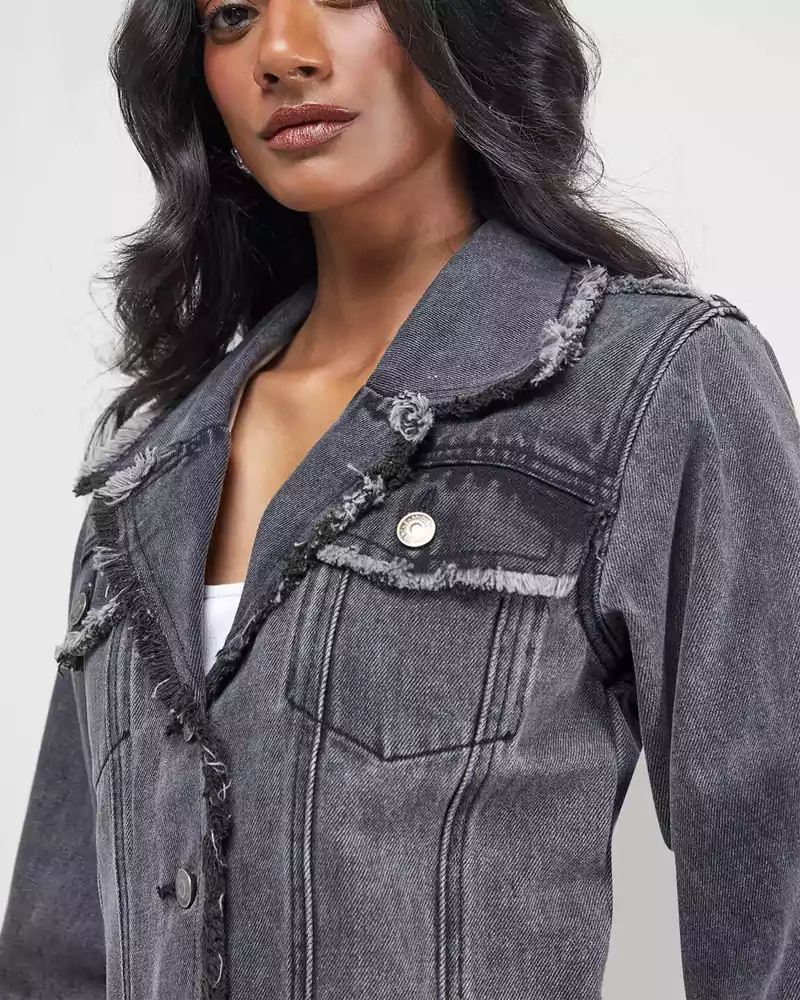
Mens denim jacket custom low moq

1. Introduction: The Low-MOQ Revolution in Denim
The men’s denim jacket has long been the province of bulk. Factories quoted thousands of pieces, and the independent brand with a hundred-unit ambition was met with polite silence. That orthodoxy has cracked. A new generation of suppliers now offers custom men’s denim jackets at minimums of fifty pieces — some far lower — and the consequences for small labels, influencers, and first-time importers are profound.
The shift is structural, not sentimental. Flexible factories, digitized decoration, and a market of startup brands have combined to make the small run commercially viable. The result is a sourcing landscape where “low MOQ” is a genuine option rather than a marketing phrase. This guide explains what low MOQ means, what it costs, how to find suppliers who genuinely honor it, and how to run a small custom denim program without tripping over its economics.
2. What “Low MOQ” Actually Means — and What It Costs
A minimum order quantity is the factory’s threshold for economic survival. It exists to amortize fixed costs — pattern grading, fabric cutting markers, wash setup, embroidery digitizing — across enough units that the campaign makes sense. When a supplier advertises a low MOQ, they are not being generous; they are offering you a share of those fixed costs in exchange for a higher unit price.
Understand the exchange rate. A 50-piece order spreads a US$150 digitizing fee at three dollars per jacket; a 500-piece order carries it at thirty cents. The low-MOQ supplier compensates for the thin base by pricing the unit higher. That is the entire bargain: you pay more per piece to pay far less in total. For a young brand, the trade is almost always rational — deadstock is more expensive than markup.
3. The Spectrum of Minimums: From Single Pieces to Five Hundred
3.1 Blank Customization: The Minimum of One
At the extreme end of flexibility sits blank customization. Some manufacturers will customize a stock denim jacket — embroidery, printing, labels — in quantities as small as a single piece. Zenith Denim, for example, quotes a minimum of one piece for customizations applied to its existing jacket blanks, with lead times of five to seven business days .
The economics are clear: you cannot choose the cut, the fabric, or the wash — only what decorates the garment. But for a personal gift, a founder’s jacket, or a market test before committing to a run, the minimum of one is invaluable. It is the cheapest research instrument in apparel.
3.2 Semi-Custom Programs: The 50–100 Piece Sweet Spot
The practical heart of the low-MOQ market is the fifty-to-one-hundred-piece program. Manufacturers such as ZORWILD offer custom men’s denim jackets at a 50-piece minimum with sample turnaround around seven days, explicitly courting startup brands and small wholesalers . Potato Apparel runs OEM and ODM programs from 50 pieces per style, permitting colors and sizes to be mixed within the order .
At this tier, the buyer chooses the fit direction, the wash family, the hardware, and the decoration — within the factory’s existing capabilities. The garments are not truly bespoke, but they are genuinely yours. For a first collection or a capsule drop, this is the rational entry point.
3.3 Full Custom: When Two Hundred Becomes the Floor
True full custom — a unique cut, a proprietary fabric, a bespoke wash — carries a heavier threshold. The same manufacturer that customizes blanks at a minimum of one requires roughly 200 pieces for a fully custom jacket with a unique pattern and materials . Elsewhere, full custom programs commonly require 300 to 500 pieces per design .
The threshold is not arbitrary. A new pattern demands grading across sizes, a cutting marker, and a fit-development cycle; a proprietary fabric demands a dye lot and a weaving commitment. These costs are real, and no factory can absorb them across fifty units. If your ambition is a truly original garment, budget for the larger minimum — or begin at the semi-custom tier and evolve.
4. Why Low Minimums Exist Now — The Structural Shift
The low-MOQ supplier is not a new species; it is an adaptation to a changed environment. Three forces made the small run viable.
The first is decoration technology. Digital printing and in-house embroidery have eliminated the setup-heavy screens and plates that once made small batches punitive. When a factory holds 95 percent of its decoration capability in-house, as ZORWILD advertises, the marginal cost of a fifty-piece run collapses . The second force is market structure: the rise of influencers, direct-to-consumer labels, and micro-wholesalers created demand for inventory that does not require a warehouse. The third is competitive pressure among factories in saturated garment hubs, where flexibility has become the differentiator that price alone once was. The result is a market that treats small buyers as customers rather than nuisances.
5. The True Cost of a Small Minimum
Low MOQ is a freedom, and like all freedoms, it has a price. The unit premium is the visible cost; the hidden ones are subtler.
Expect to pay a per-piece premium of 20 to 50 percent over the same garment quoted at a five-hundred-piece minimum. Expect, too, the fixed-cost sharing to appear in unexpected places: a higher sample fee, a decoration setup charge, a minimum fabric purchase that exceeds the garment count. And expect the trade-off to appear in lead time — small runs often wait for a production slot rather than commanding one.
None of these costs are unreasonable. The question is whether they fit your arithmetic. A brand that sells through its run at full margin can absorb a 40 percent unit premium; a brand that must discount to move fifty jackets cannot. Run the numbers before you celebrate the low minimum.
6. How to Identify a Genuinely Low-MOQ Supplier
6.1 Red Flags on the Marketplace
The sourcing platforms are crowded with claims, and “low MOQ” is among the most abused phrases in the catalogue. Treat the advertised minimum with suspicion until it survives three questions.
First: is the MOQ per style or per color? A supplier who quotes fifty pieces but demands twenty-five per color has effectively raised your minimum. Second: does the minimum include the decoration? Some factories quote a low MOQ for blank garments and a far higher one once embroidery or printing enters the spec. Third: is the figure negotiable, or is it a floor carved in stone? A supplier who bends on the minimum may also bend on quality. Verify the claim by requesting a quotation in writing, with the MOQ, the price, and the decoration scope on the same document.
6.2 The Capability Audit, Compressed
For a small order, a full factory audit is disproportionate — but a compressed one is essential. Ask three questions. Does the factory run its decoration in-house, or does it outsource to a third party whose schedule it cannot control? Does it hold current compliance documentation — OEKO-TEX, REACH, or the destination-market equivalents — for denim and trims? And can it produce a sample within ten business days of the tech pack? The answers separate the flexible manufacturer from the trading company that simply relays orders to someone else’s factory.
7. The Smart Strategy: Decorate the Blank, Customize the Trim
The most economical route to a “custom” men’s denim jacket at low volume is not full custom at all — it is the decorated blank. Buy a stock silhouette you approve, then make it yours through decoration and trim.
The levers are inexpensive and effective. A chest embroidery and a back print convert a commodity jacket into a branded one. Custom woven labels, a branded hang tag, and a distinct button finish do the same at the point of inspection. The blank itself carries no pattern-development cost, and the factory’s minimum falls accordingly. The result is a jacket that reads as designed, at a fraction of the full-custom price — the strategy of choice for the first collection, the capsule drop, and the test market.
8. The Tech Pack That Keeps a Small Order Honest
Small orders forgive no ambiguity. A 500-piece run can absorb a misplaced measurement and still yield sellable stock; a 50-piece run carries every error to the surface. The tech pack is therefore not a formality but the instrument of survival.
Send the factory a document with the flat sketch, the measurement table in centimeters and inches, the fabric weight and composition, the wash reference, the artwork in vector format with Pantone values, the hardware list, and the quantity per size. Specify the acceptable shrinkage tolerance and the decoration placement to the millimeter. A precise tech pack earns an accurate quote and a compliant sample; a vague one earns a hedge, and hedges multiply in small runs.
9. Sampling Economics at Low Volume
At low volume, the sample is proportionally more expensive and disproportionately more important.
Expect a sample fee that may or may not be credited against the production order — ask, and get the answer in writing. Expect one to three sampling rounds before approval, each consuming a week or more; the industry norm for custom denim jackets, including sampling, is four to eight weeks of lead time . And insist on a pre-production sample sewn from the actual fabric, with the actual wash, before the run begins.
The discipline is simple: freeze the sample as the contract. Photograph it, measure it, and record the wash shade in an approval document. In a fifty-piece order, every defect is a measurable fraction of your sellable stock. The sample is the cheapest insurance you will ever buy in this category.
10. The Price Terrain for Men’s Custom Denim Jackets
The market for men’s custom denim jackets spans a broad band, and the low-MOQ end is genuinely accessible. Current marketplace data illustrates the spread.
| Tier | Indicative MOQ | Indicative FOB (per piece) |
|---|---|---|
| Retail-level wholesale, single-piece | 1–2 pcs | US$25 – US$46 |
| Low-MOQ custom (semi-custom) | 50–100 pcs | US$17 – US$25 |
| Standard custom | 100 pcs | US$10.60 – US$19 |
| Full custom / OEM at scale | 300–500 pcs | US$14.50 – US$19 |
The figures tell a consistent story. A men’s denim jacket in polyester-cotton twill lists at roughly US$10.60–12.00 per piece at a 100-piece minimum on Made-in-China.com . Custom loose-fit and decorated styles climb to US$15.90–18.90 at a 50-piece minimum on the same platform . On Alibaba, distressed and appliquéd men’s denim jackets quote at US$16–19 with a 100-piece MOQ, while OEM suppliers in Pakistan and Southeast Asia offer decorated jackets from roughly €14.77–17.37 at minimums as low as two to five pieces . At the single-piece wholesale end, finished branded jackets on DHgate run from roughly US$25 to US$46 .
The lesson is arithmetic. The single-piece price includes decoration, fulfillment, and the supplier’s margin; the hundred-piece FOB price assumes you will supply the specification and the patience. Both are legitimate. The buyer’s task is to choose the tier that matches the ambition.
11. Scaling Up: The Path from Fifty to Five Hundred
The low-MOQ order is a beginning, not a destination. The strategy that serves the startup best is a ladder: test at fifty, prove at one hundred, scale at three hundred.
The test run validates the silhouette, the fit, the wash, and the sell-through. The hundred-piece order tests the supply chain at moderate risk, establishing the working relationship and the quality baseline. The three-hundred-plus order captures the price break that makes the program profitable — at which point the per-piece premium of the low-MOQ era becomes a memory rather than a burden.
The negotiation should anticipate this trajectory. Secure the price-break schedule in writing at the first order: the factory knows the volume tiers; you should too. A supplier who quotes fifty pieces today and a lower unit price at three hundred tomorrow is a partner in your growth. One who quotes only today is a vendor.
12. Conclusion: A Small Order Is a Door, Not a Ceiling
Low-MOQ sourcing has democratized the men’s denim jacket. The independent brand no longer needs a warehouse to launch; the influencer no longer needs a backer; the wholesaler no longer needs to gamble on a thousand units to test a silhouette. The fifty-piece minimum, the seven-day sample, and the decorated blank have turned custom denim from a privilege of scale into a tool of the small operator.
The discipline remains. Understand what the low minimum costs, verify the supplier’s claims, keep the tech pack exact, and treat the sample as the contract. The market’s current pricing — from the decorated single pieces near twenty-five dollars to the hundred-piece programs near eleven — rewards the buyer who matches the tier to the ambition.
The small order is not a compromise; it is a strategy. It is how a label learns, tests, and fails cheaply — and how it eventually arrives at the scale where the price list bends in its favor.