Don't miss our holiday offer - up to 50% OFF!

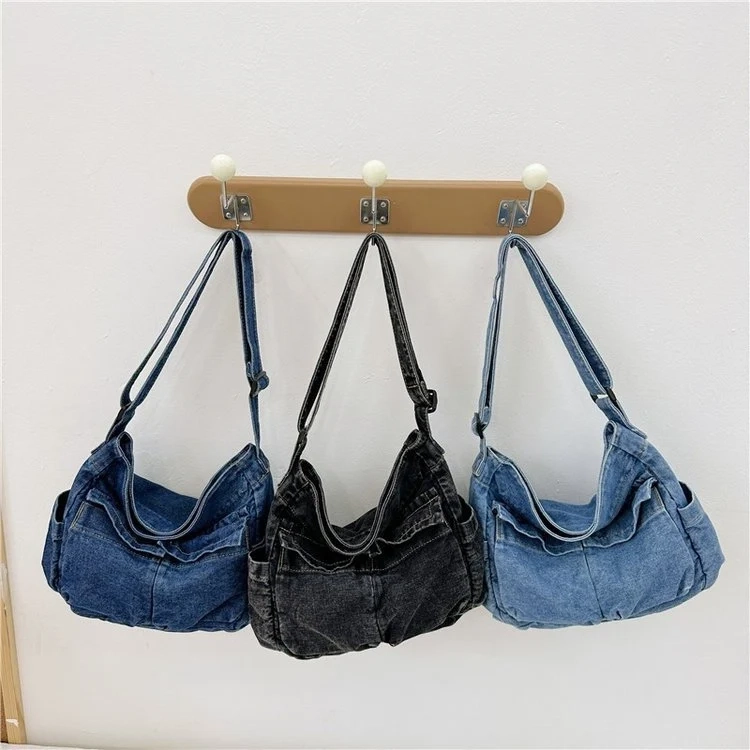
low moq eco recycled women jean denim shoulder bags denim canvas tote bag with custom logo

Introduction: The Confluence of Sustainability, Utility, and Brand Identity
The contemporary branded merchandise landscape is undergoing a material transformation. The synthetic non-woven tote, once the ubiquitous vessel of corporate giveaways, is being supplanted by objects of greater substance and integrity. At the vanguard of this shift stands the low-MOQ eco-recycled women’s denim shoulder bag and the custom logo denim canvas tote. These are not disposable artifacts. They are utilitarian objects with a distinct material story—one that speaks of reclaimed fibers, responsible production, and a rejection of the ephemeral. For brands seeking to signal environmental stewardship without abandoning commercial pragmatism, these denim bags offer a compelling proposition.
The Material Foundation: Recycled and Eco-Friendly Denim
Post-Consumer and Post-Industrial Recycled Cotton
The foundational claim of the eco-recycled denim bag rests upon its material provenance. Recycled cotton is derived from two primary streams: post-consumer material, which refers to garments and textiles that have reached the end of their useful life; and post-industrial material, which encompasses manufacturing waste such as cutting scraps and rejected panels . The distinction is not merely semantic. Post-consumer recycled cotton carries a more compelling sustainability narrative, as it diverts waste from landfills and reduces the demand for virgin fiber cultivation. Brands that can verify their supply chain’s inclusion of post-consumer content gain a more credible ecological positioning.
The Certification Landscape: RCS and GRS Explained
The integrity of recycled content claims is governed by voluntary certification standards. The Recycled Claim Standard (RCS) verifies the presence and percentage of recycled material in a final product, tracking the flow from recycling stage to finished good . A product containing at least 95% recycled content may bear the “RCS 100” label grade; content between 5% and 95% falls under “RCS Blended” . The Global Recycled Standard (GRS) imposes a more comprehensive framework, requiring a minimum of 20% recycled material and extending certification to environmental management, social responsibility, and chemical restrictions throughout the production chain . For brands making substantive sustainability claims, GRS certification offers a more rigorous and defensible foundation.
Denim Canvas: A Durable and Flexible Substrate for Bags
Denim’s suitability for bag construction is well established. The fabric’s twill weave, characterized by diagonal ribbing, confers exceptional resistance to tearing and abrasion . When repurposed for bags, denim provides a structural integrity that lighter cottons cannot match. Cotton canvas—the closely related plain-weave fabric—offers a smoother surface that accepts printing with exceptional clarity, absorbing ink deeply to produce vivid, permanent color . The combination of denim’s rugged character and canvas’s printability creates a versatile foundation for both shoulder bags and totes.
The Low MOQ Paradigm: Accessibility for Emerging Brands
Traditional MOQ Barriers in Bag Manufacturing
Minimum order quantities have historically served as the gatekeepers of custom bag manufacturing. Traditional factories impose minimums of 250 to 500 units per style and color, driven by the economics of fabric procurement, cutting efficiency, and production setup . For emerging brands, independent designers, and small businesses testing new product lines, these thresholds present prohibitive barriers. The capital required to commission a production run of several hundred units may exceed the available budget of a nascent enterprise.
Flexible Production Models and Tiered Minimums
A growing segment of manufacturers has responded by introducing lower MOQ tiers. Some factories now offer trial orders of 50 to 100 pieces at adjusted pricing, enabling brands to validate designs and market response before committing to larger volumes . The MOQ landscape is now stratified: logo application on stock bags may require 200 pieces; stock shape with custom color and logo increases to 500 pieces per color; full custom specifications command minimums of 1,000 units . The practical entry point for a low-MOQ denim bag—where the brand supplies the design, and the factory executes on a stock or slightly modified silhouette—may be as low as 50 to 100 pieces, depending on the manufacturer and the complexity of the specification.
The Women’s Jean Denim Shoulder Bag: Design and Construction
Silhouette and Dimensions for Everyday Utility
The women’s denim shoulder bag occupies a middle ground between the capacious tote and the compact crossbody. Its dimensions are calibrated for daily carry: large enough to accommodate essentials—wallet, phone, keys, perhaps a small notebook—yet compact enough to avoid the bulk of a full-size carryall. The silhouette may be structured or slouchy, rectangular or crescent-shaped, depending on the intended market positioning. For retail-oriented programs, a structured profile with exterior pockets and metal hardware signals a higher perceived value .
Reclaimed Denim Aesthetics: Patches, Waistbands, and Stitching
The aesthetic identity of the recycled denim shoulder bag is derived from the material’s visible history. Patchwork constructions, wherein panels of varying washes and textures are joined, create a visual narrative of reuse . Waistbands, pockets, and belt loops salvaged from original garments may be incorporated as functional embellishments . The stitching becomes a design element: contrast thread, visible seams, and reinforced bar tacks all contribute to a handcrafted, artisanal character. Each bag is, in a meaningful sense, unique—a quality that resonates with consumers seeking objects of character rather than uniformity.
Functional Add-Ons: Closures, Linings, and Straps
Customization extends beyond the exterior. Functional add-ons enhance usability and brand perception. Zipper closures offer security; magnetic snaps provide convenience; flap closures evoke a heritage aesthetic . Inner linings, whether fabric or a lightweight synthetic, improve the bag’s finished appearance and protect contents. Adjustable straps, webbing handles, or reinforced tote handles may be specified to suit carrying preferences . Hardware—buckles, D-rings, snap hooks, rivets—can be selected in finishes that complement the denim’s color palette.
The Denim Canvas Tote: A Workhorse of Sustainable Branding
Capacity and Structural Considerations
The denim canvas tote is a larger, more utilitarian proposition. It is designed to carry groceries, books, laptops, or promotional materials. The base may be gusseted to allow the bag to stand; the handles are typically reinforced with bar tacks at the attachment points to withstand repeated loading . The interior may feature slip pockets or a zippered compartment for organization. The tote’s generous front panel offers ample space for logo application, making it an effective mobile billboard for the brand.
The Tote as a Reusable Promotional Vehicle
The promotional tote has long been a staple of corporate marketing. The denim canvas iteration elevates this category by offering a material that recipients are more likely to reuse. A well-constructed denim tote becomes an everyday object—a grocery carrier, a gym bag, a library companion. Each use generates an impression, and the cumulative effect over the bag’s lifetime is substantial. The 2023 ASI Ad Impressions Study found that bags generate an average of 1,940 impressions over their lifetime . A bag that is actively used rather than relegated to a closet achieves the upper end of that range.
Custom Logo Application: Methods and Considerations
Screen Printing: The Standard for Cotton Canvas
Screen printing remains the default method for logo application on cotton canvas and denim. The process deposits ink through a mesh screen, producing a flat, bold graphic with excellent opacity . Water-based inks on cotton yield a softer hand-feel than plastisol, soaking into the fiber rather than sitting on its surface, so the print becomes integrated with the fabric . Screen printing is economical at volume—the setup cost is amortized across the production run—and the print’s durability, exceeding 50 washes, is well-suited to a bag intended for long-term use .
Embroidery: Premium Texture and Durability
Embroidery offers a distinct aesthetic and a superior durability profile. Stitched directly into the fabric with thread, embroidery produces a raised, tactile finish that reads as premium . It is virtually immune to the fading and cracking that can afflict printed graphics. Embroidery is particularly suited to clean, bold logos with minimal fine detail; the medium cannot reproduce gradients, and minimum letter heights of 3/16 inch apply . For a denim bag positioned as a gift or a premium retail item, embroidery justifies its higher per-unit cost.
Woven Labels, Patches, and Hardware Branding
Beyond direct application, branding may be achieved through sewn components. Woven labels offer fine detail in a compact format; heat-sealed or sewn patches provide a tactile brand marker; debossed leather or faux-leather patches lend a heritage quality . Engraved metal hardware—buttons, rivets, zipper pulls—can incorporate the brand’s mark, creating a subtle but persistent signature. These applied branding methods often outlast surface printing and contribute to the bag’s overall perception of quality.
Quality Assurance in Custom Denim Bag Production
Fabric Batch Consistency and Colorfastness
Denim is a variable material, particularly when recycled or upcycled content is involved. Color variation between fabric batches is a genuine risk, and manufacturers must implement batch matching protocols to ensure consistency across a production run . Colorfastness testing—verifying that the dye does not transfer or fade—is essential, particularly for bags intended for frequent handling and exposure to the elements.
Handle Attachment and Load-Bearing Integrity
The handle attachment is the single most critical load-bearing point in any bag. A handle stitched as a simple strip is vulnerable to failure under load. Bar-tacked handles, integrated into the seam and reinforced with additional stitching, offer far greater tensile strength . Tensile testing—applying measured force to the handle until failure—is the standard method for verifying attachment integrity. For totes intended to carry groceries or heavy items, this testing is non-negotiable.
Sampling Protocols for Bulk Consistency
The pre-production sample is the definitive specification against which bulk production is measured. For denim bags, the sample must be produced from the actual bulk fabric, with the final wash and hardware, to account for the material’s dimensional behavior . The approved sample is sealed and retained; any subsequent shipments are compared against it for color, construction, stitching density, and hardware placement. This protocol is the primary safeguard against the drift that can occur across a production run.
Conclusion: The Strategic Value of Low-MOQ Custom Denim Bags
The low-MOQ eco-recycled women’s denim shoulder bag and denim canvas tote represent a convergence of values and commerce. For the brand, they offer a promotional artifact of genuine quality—an object that recipients will use, retain, and associate with the giver. For the consumer, they offer utility without environmental compromise. The barriers to entry have never been lower. Manufacturers now accommodate orders of 50 to 200 pieces, enabling emerging brands and small businesses to access production runs that were once the preserve of established enterprises. The certification frameworks exist to verify sustainability claims. The construction techniques are well-established. What remains is the strategic discernment to select the right silhouette, the right decoration method, and the right manufacturing partner. The denim bag, in its many forms, is a vessel—for groceries, for laptops, for branded aspirations.