Don't miss our holiday offer - up to 50% OFF!

Custom Denim Solutions: End-To-End Manufacturing And Design Help

In today’s dynamic and highly personalized fashion landscape, standing out requires more than just off-the-rack offerings. For brands, startups, and established labels alike, the key to differentiation lies in unique, high-quality products that tell a compelling story. Denim, a perennial cornerstone of global fashion, is at the forefront of this shift. The demand for custom denim—be it tailored fits, unique fabrics, innovative washes, or bespoke detailing—is soaring. However, navigating the complex journey from a nascent idea to a finished, market-ready pair of jeans is a formidable challenge. It requires seamless integration of creative design, technical expertise, and precise manufacturing. This is where the concept of end-to-end custom denim solutions becomes not just valuable, but essential. By providing comprehensive design help coupled with full-spectrum manufacturing, specialized partners empower brands to transform their vision into tangible, exceptional products without the traditional hurdles of production.
Understanding the Custom Denim Landscape
The custom denim market has evolved far beyond basic sizing adjustments. It now encompasses a complete spectrum of personalization and brand-specific creation.
- The Rise of Bespoke Demand: Consumers and brands are moving away from mass-produced uniformity. There is a growing appetite for limited editions, sustainably produced pieces, and jeans that reflect individual or brand identity. This demand pushes brands to seek manufacturing partners capable of handling small to medium runs with high levels of customization.
- Challenges in Sourcing and Production: Traditionally, creating custom denim involved coordinating with multiple disjointed entities: a fabric supplier, a trim source, a sample room, a wash house, and a factory for assembly. This fragmented process leads to communication breakdowns, quality inconsistencies, extended timelines, and inflated costs. For brands without deep industry connections, this maze can be impossible to navigate successfully.
- The Solution: Integrated Services: The modern answer to these challenges is a holistic, end-to-end service model. This approach consolidates every step of the journey under one coordinated umbrella, ensuring coherence, quality control, and efficiency from the first sketch to the final packaged product.
The End-To-End Journey: From Concept to Creation
A true end-to-end solution is a partnership that guides a brand through each critical phase of development.
Phase 1: Collaborative Design and Development Help
This foundational phase is where ideas are shaped into viable products.
- Concept Consultation: Experts work with clients to refine their vision, considering market trends, target audience, and brand ethos.
- Technical Design and Pattern Making: Skilled technicians translate sketches into precise technical flats and digital patterns. This stage is crucial for achieving the intended fit, silhouette, and proportion. Multiple fit iterations ensure perfection.
- Fabric and Trim Sourcing: Leveraging extensive networks, the partner presents a curated selection of custom denim fabrics (from raw selvedge to advanced stretch blends) and specialized trims (buttons, rivets, patches, threads). They handle all sourcing logistics, quality checks, and compliance matters.
- Sample Creation: A first sample (prototype) is constructed based on the approved patterns and materials, providing a physical form for assessment and refinement.
Phase 2: Artistry in Denim Washing and Finishing
Denim’s character is largely defined in the wash house. This artisanal phase requires sophisticated expertise.
- Wash Development: Technicians develop custom wash recipes to achieve specific looks—from classic clean finishes to heavily distressed, vintage, or eco-friendly laser-treated effects.
- Prototype Washing: The initial samples undergo washing to visualize the final hand-feel, color, and aesthetic. Adjustments are made iteratively until the perfect finish is achieved.
- Sustainability in Washing: Leading providers invest in sustainable technologies such as ozone fading, laser detailing, and water recycling systems to minimize environmental impact without compromising on style.
Phase 3: Precision Manufacturing and Production
With designs and washes finalized, the process moves to scaled production.
- Pre-Production Planning: Detailed production schedules, graded patterns for all sizes, and meticulous cut plans are finalized to optimize fabric utilization and efficiency.
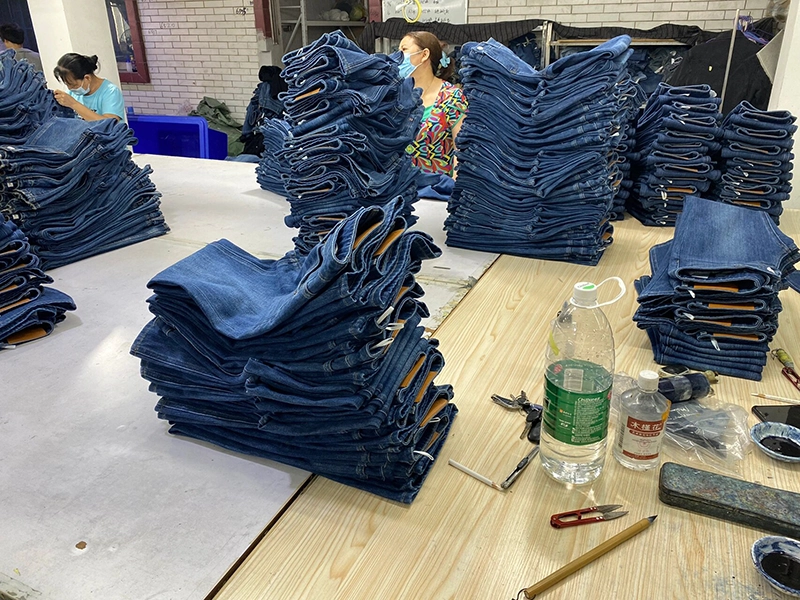
- Cutting, Sewing, and Assembly: Using state-of-the-art equipment, fabric is precisely cut and assembled by experienced tailors. Quality control is embedded at every stage of sewing to ensure durability and consistency.
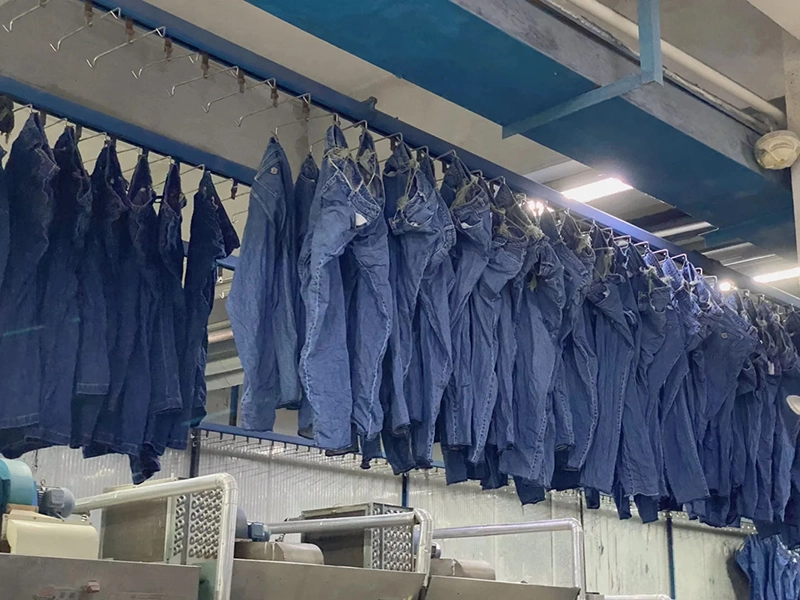
- Final Washing and Finishing: Garments undergo their approved wash process in bulk, then are dried, pressed, and inspected.
- Quality Assurance and Final Inspection: Every single piece undergoes a rigorous final inspection against quality standards for construction, finish, wash, and labeling before being approved for shipment.
Phase 4: Logistics and Post-Production Support
The partnership extends beyond the factory floor.
- Labeling, Tagging, and Packaging: Products are branded with the client’s labels, hangtags, and prepared with custom packaging as required.
- Global Logistics and Shipping: The manufacturer manages the complexities of international shipping, customs clearance, and delivery, ensuring products reach the brand’s doorstep or distribution center smoothly.
The Tangible Benefits of a Full-Service Partnership
Choosing an end-to-end partner delivers significant strategic advantages:
- Time and Cost Efficiency: Eliminating multiple middlemen reduces lead times and prevents cost overruns from communication errors or reworks.
- Uncompromised Quality Control: Having control over every stage in a unified process guarantees consistent, high-quality output that aligns with the brand’s specifications.
- Scalability and Flexibility: Partners can accommodate orders of varying sizes, from small pilot runs to larger production cycles, allowing brands to test markets and manage inventory effectively.
- Access to Expertise and Innovation: Brands benefit from the partner’s deep material knowledge, wash-house artistry, and technical know-how, often gaining access to innovative techniques and sustainable practices they wouldn’t find elsewhere.
- Reduced Operational Burden: Brands can focus their energy on core activities like marketing, sales, and brand building, while the manufacturing expert handles the complex production logistics.
Proof of Capability: ZENITH CLOTHING – Your End-To-End Denim Partner
At ZENITH CLOTHING, we do not just advocate for this integrated model; we live and breathe it every day. We are a professional garment manufacturing company with a specialized, deep-rooted passion for denim. Our brand is built on the very principles outlined in this article.
Our state-of-the-art facility is designed to be a vertical hub for custom denim creation. We house in-house design and technical teams who work collaboratively with our clients. Our sampling department is equipped to rapidly turn ideas into prototypes. We have established strong, direct relationships with premier fabric mills from Japan, Turkey, and Italy, allowing us to source the best materials for your vision. Most importantly, our dedicated wash development unit, equipped with both traditional and innovative sustainable technologies, is where the magic happens, giving your denim its unique soul.
From the initial concept shared over a coffee to the final carton being loaded for shipment, ZENITH CLOTHING manages it all with precision, transparency, and a shared commitment to excellence. We prove that a single, dedicated manufacturing partner can elevate a brand’s potential, turning the complex dream of custom denim into a seamless, successful reality. Let us help you build your legacy in denim, one perfectly crafted pair at a time.