Don't miss our holiday offer - up to 50% OFF!

How is denim made

From Cotton to Icon: The Comprehensive Guide to Denim Fabrication
Denim is more than a fabric; it is a global cultural icon, synonymous with durability, workwear, and timeless style. The journey from a fluffy cotton boll to the beloved pair of blue jeans is a fascinating saga of agriculture, industrial innovation, and meticulous craftsmanship. This article delves deep into the intricate, multi-stage process of how denim is truly made.
Stage 1: The Raw Material – Sourcing the Cotton
The foundation of all denim is cotton. The quality, staple length (fiber length), and origin of the cotton directly influence the hand-feel, durability, and appearance of the final fabric.
- Cultivation and Harvesting: The process begins in cotton fields across the globe, from the United States and India to Australia and West Africa. The type of cotton used is crucial. Upland cotton is common for its affordability and good yield, while Extra-Long Staple (ELS) cottons like Pima, Supima®, or Egyptian varieties produce finer, stronger, and noticeably softer denim. Once the cotton bolls ripen, they are harvested either mechanically by large pickers or, in some regions, still by hand.
- Ginning: The harvested cotton is transported to a gin. Here, the gin separates the valuable cotton fibers (lint) from the seeds, hulls, and other plant debris. The cleaned, fluffy cotton lint is then compressed into dense bales, each weighing approximately 500 pounds, ready for spinning.
Stage 2: Spinning – Creating the Yarn
At the spinning mill, the cotton bales undergo a transformation from loose fibers into strong, continuous threads.
- Opening, Blending, and Carding: Multiple bales are opened and blended to ensure consistency. The cotton is then carded, a process where it is passed through wire-toothed cylinders that disentangle and align the fibers into a loose rope called a sliver. This removes short fibers and residual impurities.
- Drawing and Roving: Several slivers are combined and drawn out (stretched) to further align the fibers and improve uniformity. They are then lightly twisted into a thicker, softer strand called a roving.
- Spinning: The roving is fed into spinning frames where it is drawn out to the desired fineness and twisted vigorously. This twist is what gives the yarn its essential strength. For denim, two primary yarns are created: the sturdy warp yarn (lengthwise) and the typically softer weft or filling yarn (crosswise).
Stage 3: Dyeing – The Birth of the Blue
This is the stage where denim gets its signature blue color, exclusively applied to the warp yarns, while the weft yarns remain raw (undyed) white.
- Indigo Synthesis: While natural indigo exists, over 99% of modern denim uses synthetic indigo. It is chemically identical to the plant-based version but provides greater consistency, colorfastness, and scale for mass production.
- The Slasher Dyeing Process: The most common method is rope dyeing, considered the premium technique. Hundreds of warp yarns are gathered into a thick rope, passed through a series of sequential dye baths. In each bath, the yarns absorb a small amount of indigo and are then oxidized (exposed to air) in between dips. This “dipping and oxidizing” cycle is repeated 6-12 times to build up the rich, layered blue hue. Because the dye only penetrates the outer layer of the yarn, the core remains white, setting the stage for iconic fading and wear patterns.
- Sizing: After dyeing, the warp yarns are coated with a starch-based size. This adhesive layer protects the yarns during the high-stress weaving process, reducing breakage and adding smoothness.
Stage 4: Weaving – Constructing the Fabric
On the loom, the dyed blue warp and the white weft yarns are interlaced to form the denim cloth.
- The Loom: Traditional shuttle looms create a selvage denim (noted by the colored, self-finished edge), prized for its quality and tight weave, but they are slower. Today, most denim is woven on high-speed projectile or air-jet looms, which offer incredible efficiency and consistency.
- The Twill Weave: Denim is defined by its twill weave. In this pattern, the weft yarn passes under two or more warp yarns, then over one, with the pattern shifting one yarn to the right or left on each pass. This creates the familiar diagonal ribbing, known as the twill line. The most common is the 3×1 right-hand twill (where the weft goes under three blue warp yarns, then over one). A broken twill weave helps prevent leg twisting in jeans. The prominence of the twill line, the tension on the loom, and the thickness of the yarns all contribute to the fabric’s character.
Stage 5: Finishing – Enhancing Feel and Function
Fresh off the loom, the denim fabric (called greige or loomstate) is stiff, dark, and not ready for wear. Finishing processes prepare it for the customer.
- Singeing: The fabric passes over a gas flame to burn off surface fuzz, creating a cleaner, smoother appearance.
- Desizing: The protective starch applied before weaving is washed out.
- Sanforization: A critical pre-shrinking process. The fabric is moistened with steam, stretched over a curved rubber belt, and dried. This mechanically reduces residual shrinkage to below 3%, ensuring a pair of jeans will not shrink significantly after purchase.
- Additional Washes and Treatments: At this stage, mills may apply various finishing washes to the bulk fabric to achieve different aesthetics:
- Stone Washing: Tumbling fabric with pumice stones to soften and create abrasion marks.
- Enzyme Washing: Using biological enzymes (like cellulase) to soften fabric and create a worn look more gently than stones.
- Bleaching: Using light oxidants to strip color for high-contrast fades.
- Calendering: Pressing the fabric between heavy rollers to create a slight sheen or specific surface texture.
Stage 6: Garment Manufacturing – From Fabric to Jeans
The finished denim roll is now shipped to apparel manufacturers. Here, it is cut, sewn, and transformed into the final product.
- Pattern Making, Cutting, and Sewing: Using computerized markers for efficiency, hundreds of layers of denim are cut simultaneously with precision lasers or band knives. Skilled operators then sew the pieces together on industrial machines, attaching rivets, buttons, and zippers. Iconic details like the double-stitched seam and bartacks at stress points are added for durability.
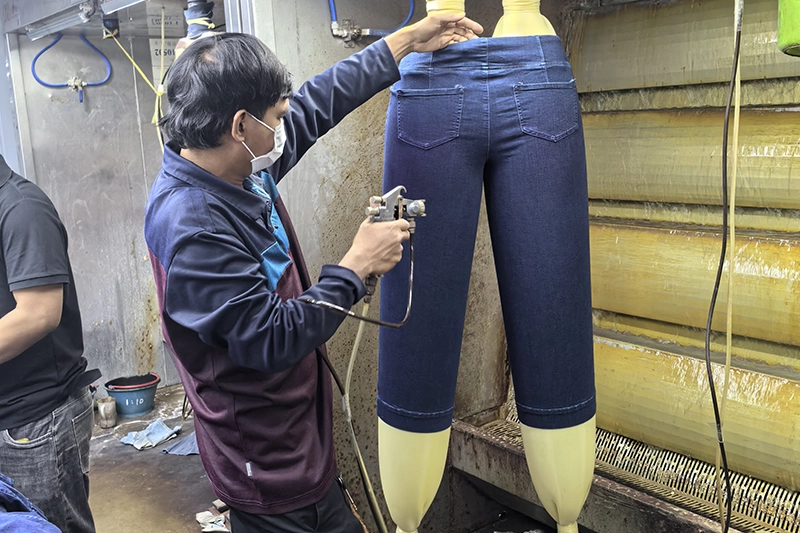
- Garment Washing and Detailing: Jeans are almost always washed again as finished garments. This is where the real magic of individual character happens. Techniques like hand sanding, grinding, whiskering (creating fade lines on the thighs), potassium permanganate spraying (for localized bleaching), and laser etching are used to create precise wear patterns and fades. Each pair is then tumbled, dried, and pressed.
Innovations and Sustainability
The modern denim industry is intensely focused on innovation and reducing its environmental footprint.
- Sustainable Practices: This includes using organic cotton, recycled cotton fibers, and lyocell (like TENCEL™). Water-saving technologies like foam dyeing and ozone fading are gaining traction. Closed-loop water systems and eco-friendly dyes and chemicals are becoming industry standards.
- Advanced Fabrics: Developments include stretch denim with advanced recovery fibers, performance denim with moisture-wicking or temperature-regulating properties, and fabrics blended with other natural fibers for unique textures.
Crafting Legacy: The ZENITH CLOTHING Commitment
Understanding the profound craftsmanship behind denim is central to our philosophy at ZENITH CLOTHING. As an experienced apparel production manufacturer, we don’t just source fabric; we partner with world-renowned mills to select the perfect denim for each garment. Our design and production teams possess a deep, technical knowledge of every stage outlined above—from how a twill weave will affect drape to how a specific dyeing method will yield unique fade characteristics.
At our facilities, this expertise comes to life. We meticulously oversee the cutting, sewing, and intricate finishing processes, ensuring that every pair of jeans bearing the ZENITH CLOTHING label is not merely clothing, but a testament to the rich heritage and innovative future of denim. We are dedicated to merging this timeless craft with modern, responsible manufacturing, creating durable, comfortable, and stylish denim that tells a story—from the cotton field to your wardrobe.