Don't miss our holiday offer - up to 50% OFF!

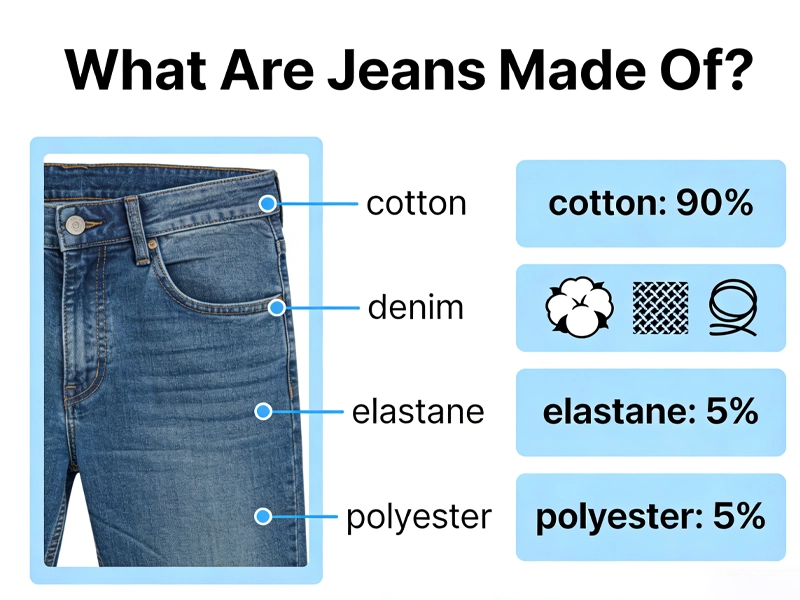
What are jeans made of

Jeans are undoubtedly one of the most ubiquitous garments in modern wardrobes. From workwear staple to high-fashion statement, they have transcended their utilitarian origins to become a global phenomenon. According to industry estimates, nearly two billion pairs of jeans are sold annually worldwide, underscoring their enduring appeal. But have you ever stopped to consider the actual materials that go into making your favorite pair? The answer to “what are jeans made of” is more nuanced than it might first appear.
At its core, denim—the fabric from which jeans are made—is a remarkable textile with a rich history and a complex composition. While traditional denim was exclusively made from cotton, modern innovations have introduced a variety of fibers and blends designed to enhance comfort, durability, and sustainability. This article delves deep into the composition of jeans, exploring everything from the origins of denim to the latest advancements in fabric technology.
At ZENITH CLOTHING, we pride ourselves on understanding every thread that goes into our garments. As a dedicated, we combine time-honored craftsmanship with modern innovation to create denim that not only looks exceptional but stands the test of time.
1. The Historical Foundation: Cotton and the Birth of Denim
1.1 The Origins of Denim Fabric
The story of denim begins in Europe long before it became synonymous with American culture. The word “denim” itself is derived from the French term “serge de Nîmes,” referring to a durable twill fabric produced in the city of Nîmes, France, as far back as the 17th century. Initially, this fabric was made from a blend of wool and silk, but it eventually evolved to incorporate cotton.
Simultaneously, the Italian city of Genoa was producing a similar cotton twill fabric known as “jean,” which was primarily used by sailors and laborers for its durability. The English later adopted both terms and materials, with “jeans” eventually becoming the name for trousers made from twilled cotton. This trans-European journey laid the groundwork for the global denim industry we know today.
1.2 Traditional 100% Cotton Denim
Traditionally, authentic denim has always been made from 100% cotton. Cotton was the natural choice for early denim manufacturers because of its unique combination of properties:
- Breathability: Cotton fibers allow air to circulate, making the fabric comfortable to wear in various climates.
- Moisture Absorption: Cotton can absorb significant moisture without feeling damp, wicking sweat away from the body.
- Durability: High-quality cotton, particularly long-staple varieties, creates strong yarns that can withstand considerable stress.
- Aging Properties: Pure cotton denim softens and fades beautifully over time, developing unique wear patterns that reflect the wearer’s lifestyle.
This 100% cotton construction creates what is known as “rigid” or “raw” denim—fabric that is stiff and sturdy when new but gradually molds to the wearer’s body, creating a personalized fit that cannot be replicated.
At ZENITH CLOTHING, we source premium cotton fibers for our rigid denim collections, ensuring that each pair develops character and patina uniquely suited to its owner.
2. The Anatomy of Denim: Understanding the Weave
2.1 The Twill Weave Structure
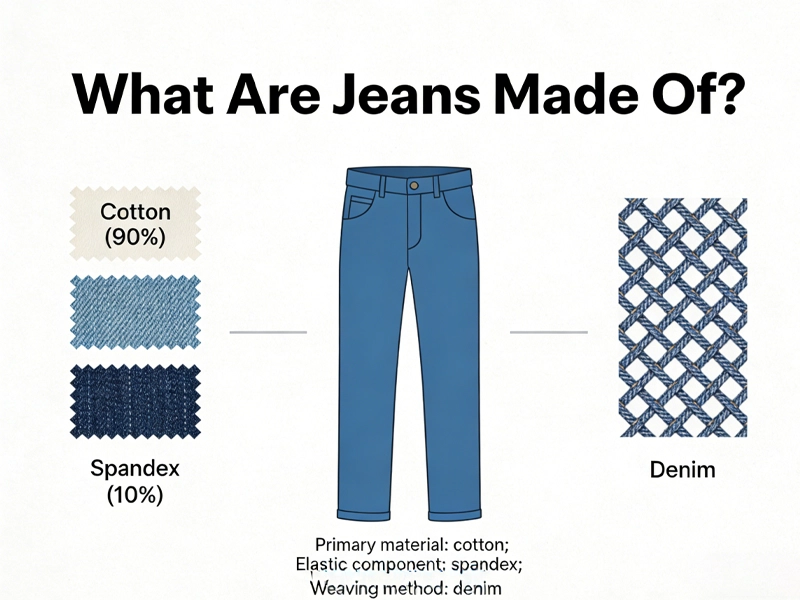
To truly understand what jeans are made of, one must look beyond the fiber content to the fabric’s construction. Denim is characterized by its twill weave, which gives the fabric its distinctive diagonal ribbing.
In a typical denim construction, the warp yarns (the lengthwise threads) are dyed—traditionally with indigo—while the weft yarns (the crosswise threads) remain undyed or “grey”. This arrangement creates denim’s iconic appearance: a blue surface with a white underside. The most common construction is a 3×1 twill, where the weft passes under three warp threads before going over one, creating a pronounced diagonal pattern.
2.2 Warp and Weft: The Heart of Denim
The interplay between warp and weft threads is fundamental to denim’s character:
| Component | Typical Treatment | Function |
|---|---|---|
| Warp Yarns | Indigo-dyed | Create the visible blue surface; provide structural strength |
| Weft Yarns | Undyed/White | Provide body and texture; remain hidden on the surface |
This structural differentiation is what allows denim to fade distinctively over time. The indigo dye adheres primarily to the surface of the warp yarns, and as the fabric wears, the white weft becomes increasingly visible—creating the coveted “fade” patterns that denim enthusiasts celebrate.
3. The Modern Evolution: Blended Fibers and Stretch Denim
3.1 The Introduction of Elastane and Spandex
While 100% cotton denim remains popular among purists, the 1980s ushered in a revolutionary change: the introduction of stretch fibers. Manufacturers began blending cotton with elastane (also known as spandex or Lycra) to create denim with enhanced flexibility and recovery properties.
Stretch denim typically contains between 1% and 4% elastane, with the remainder being cotton. This small addition transforms the wearing experience:
- Enhanced Mobility: Stretch denim moves with the body, making it ideal for slim and skinny fits.
- Shape Retention: The elastic fibers help the garment return to its original shape after wearing.
- Comfort: Reduced restriction during sitting, bending, and walking.
- Body Hugging: Creates a sleek silhouette that follows the body’s contours.
3.2 Polyester Blends and Performance Fibers
Beyond elastane, polyester has become a common component in modern denim, particularly in more affordable or performance-oriented jeans. Polyester offers several advantages:
- Increased Durability: Polyester fibers are exceptionally strong and resistant to abrasion.
- Wrinkle Resistance: Garments retain a smoother appearance with less ironing.
- Color Retention: Polyester holds dye differently than cotton, helping garments maintain their color longer.
- Quick Drying: Polyester blends dry faster than pure cotton.
Some contemporary denim formulations include significant polyester content. For example, research has documented jeans composed of 97% polyester with 3% Lycra, as well as 50/50 cotton-polyester blends. These compositions are particularly common in women’s bottoms and performance-focused styles.
3.3 Modern Innovations: TENCEL™, Lyocell, and Modal
The most recent evolution in denim composition involves the incorporation of man-made cellulosic fibers such as Lyocell (commonly known by the brand name TENCEL™) and Modal. These fibers are derived from wood pulp through closed-loop processes that recycle water and solvents, making them more environmentally friendly than many synthetic alternatives.
These innovative fibers contribute:
- Exceptional Softness: Fabrics feel smoother against the skin.
- Superior Drape: Garments hang more elegantly.
- Moisture Management: Enhanced breathability and temperature regulation.
- Biodegradability: Unlike polyester, these fibers can decompose naturally.
At ZENITH CLOTHING, we carefully select blends that optimize comfort without compromising durability. Our research and development team continuously explores innovative fiber combinations that enhance both performance and sustainability.
4. Specialty Denim Types and Their Composition
4.1 Selvedge Denim
Selvedge (or selvage) denim represents the pinnacle of traditional denim craftsmanship. Woven on shuttle looms, selvedge denim produces a clean, self-finished edge that prevents fraying. The composition is typically 100% cotton, often using premium long-staple varieties for enhanced durability and character.
The defining characteristic of selvedge denim is not its fiber composition but its construction method, which results in a denser, more rigid fabric that ages beautifully over decades rather than months.
4.2 Raw and Unwashed Denim
Raw denim refers to fabric that has not been washed after the dyeing process. It remains stiff and dark, with all the starch and sizing intact. Compositionally identical to washed denim (typically 100% cotton or cotton with minimal stretch), raw denim is distinguished by its untreated state, which allows wearers to develop personalized fade patterns based on their unique movements and lifestyle.
4.3 Bull Denim and Heavyweight Variations
Bull denim is a particularly robust variation characterized by its 3×1 twill construction and heavier weight -6. Typically weighing 11 ounces or more per square yard, bull denim is used for applications requiring exceptional durability, such as upholstery and heavy-duty workwear.
Heavyweight denims (sometimes exceeding 16 ounces) push the boundaries of what’s possible with cotton fiber, requiring specialized machinery and techniques to weave and sew.
4.4 Colored and Finished Denim
While blue remains the iconic denim color, modern jeans are available in virtually every hue. The dyeing process varies by color:
- Indigo Dyeing: Creates traditional blue denim through a fermentation or synthetic indigo process that allows the dye to adhere primarily to the surface of warp yarns.
- Sulfur Dyeing: Used for black, grey, and other dark colors, sulfur dyes penetrate the fiber more deeply, resulting in more colorfast fabric.
- Direct Dyeing: Used for brighter colors where deep penetration is less critical.
ZENITH CLOTHING offers an extensive range of colors and finishes, from classic indigo to contemporary neutrals, all achieved through responsible dyeing processes that minimize environmental impact.
5. The Complete Manufacturing Journey: From Fiber to Finished Jeans
5.1 Cotton Selection and Spinning
The journey of what jeans are made of begins long before weaving, with careful fiber selection. Cotton quality varies significantly based on staple length, with long-staple varieties like Egyptian, Supima, and Sea Island cotton producing the strongest, smoothest yarns.
The spinning process transforms raw cotton fibers into usable yarn through several stages:
- Opening and Cleaning: Compressed cotton bales are opened and fibers are cleaned of impurities.
- Carding: Fibers are aligned and formed into slivers (rope-like strands).
- Drawing: Multiple slivers are combined and drawn out to ensure uniformity.
- Roving: For ring spinning, slivers are further reduced in size.
- Spinning: Fibers are twisted into yarn using either ring spinning or open-end (rotor) spinning methods.
Ring spinning produces stronger, softer yarns suitable for premium denim, while open-end spinning offers efficiency for mass-market applications.
5.2 Warping, Dyeing, and Sizing
Before weaving can begin, the warp yarns must be prepared through a multi-stage process:
- Warping: Yarns are arranged parallel on large beams in preparation for dyeing and weaving.
- Dyeing: In denim production, dyeing occurs at the yarn stage, typically using either rope dyeing or sheet dyeing methods. Multiple dips in indigo with intermediate oxidation create the characteristic blue color.
- Sizing: Warp yarns are coated with a protective solution (typically starch-based) to reduce breakage during the high-stress weaving process.
5.3 Weaving the Fabric
Denim weaving transforms prepared yarns into fabric through the interlacement of warp and weft threads. Modern mills use high-speed airjet, rapier, or projectile looms that can insert weft threads at rates exceeding 1,800 meters per minute.
The weaving process creates the characteristic twill diagonal, which can run to the right (right-hand twill), left (left-hand twill), or alternate direction (broken twill) depending on the desired fabric characteristics.
5.4 Finishing and Treatment
After weaving, denim fabric undergoes various finishing processes:
- Singeing: Burning off surface fibers for a cleaner appearance.
- Sanforization: Mechanical pre-shrinking to control future shrinkage.
- Washing: Various washing techniques (stone wash, enzyme wash, acid wash) create different aesthetic effects.
- Ozone and Laser Treatments: Modern technologies achieve distressed effects with reduced water and chemical usage.
5.5 Cutting, Sewing, and Assembly
The final transformation from fabric to jeans involves precision cutting and expert sewing:
- Pattern Making and Marking: Creating templates for efficient fabric usage.
- Cutting: Precision cutting of fabric layers, often with computerized systems.
- Sewing: Assembly of typically 15 or more individual pieces (pockets, leg panels, waistbands, belt loops) into complete garments.
- Finishing: Final inspection, pressing, and packaging.
At ZENITH CLOTHING, our manufacturing facility oversees every step of this journey, ensuring quality control at each stage. Our experienced craftspeople combine technical precision with genuine passion for denim construction.
6. Weight and Its Relationship to Composition
6.1 Understanding Denim Weight
Denim weight is measured in ounces per square yard, and this specification significantly impacts both the composition and character of the finished jeans .
| Weight Category | Range (oz/sq yd) | Typical Applications | Composition Considerations |
|---|---|---|---|
| Lightweight | 4-8 oz | Shirts, dresses, summer jeans | Often includes synthetic blends for drape |
| Midweight | 8-12 oz | All-season jeans, jackets | Most versatile; available in all compositions |
| Heavyweight | 12-16+ oz | Workwear, winter jeans, raw denim | Typically 100% cotton for durability |
6.2 How Weight Affects Performance
The weight of denim influences everything from durability to comfort:
- Lightweight Denim (under 10 oz): Breathable and comfortable for warm weather, but less durable and may require synthetic reinforcement for shape retention.
- Midweight Denim (10-12 oz): The sweet spot for most consumers, offering good durability without excessive stiffness.
- Heavyweight Denim (13 oz and above): Exceptionally durable, develops dramatic fades, but requires break-in period and may feel restrictive initially.
ZENITH CLOTHING produces denim across all weight categories, ensuring that regardless of your preference for lightweight comfort or heavyweight heritage, you’ll find options suited to your lifestyle.
7. Sustainability and Ethical Composition
7.1 The Environmental Impact of Denim Production
Traditional denim manufacturing has significant environmental implications. Cotton cultivation requires substantial water and often involves pesticides, while conventional dyeing and finishing processes generate chemical-laden wastewater. The denim industry has historically been associated with:
- High water consumption (thousands of liters per pair of jeans in conventional production)
- Chemical pollution from dyeing and finishing
- Energy-intensive manufacturing processes
- Textile waste from cutting and unsold inventory
7.2 Sustainable Alternatives in Denim Composition
The modern denim industry is transforming through innovative approaches to composition and manufacturing:
Organic and Regenerative Cotton: Grown without synthetic pesticides or fertilizers, organic cotton reduces environmental harm. Regenerative agriculture goes further, building soil health and sequestering carbon.
Recycled Fibers: Post-consumer and post-industrial cotton can be reclaimed and blended with virgin fibers, reducing waste and resource consumption. Some manufacturers now offer denim containing significant recycled content.
Water-Efficient Dyeing: Technologies such as foam dyeing, air dyeing, and waterless indigo application dramatically reduce water usage.
Certifications: Responsible manufacturers seek certifications including GOTS (Global Organic Textile Standard), OEKO-TEX®, BCI (Better Cotton Initiative), and GRS (Global Recycled Standard) to verify their environmental claims.
ZENITH CLOTHING is committed to sustainable innovation. We continuously invest in technologies and materials that reduce our environmental footprint while maintaining the quality our customers expect. Our sustainability roadmap includes increased use of organic and recycled fibers, water conservation initiatives, and transparent supply chain practices.
8. How to Choose Jeans Based on Composition
8.1 Matching Composition to Lifestyle
Understanding what jeans are made of enables smarter purchasing decisions aligned with individual needs:
For Everyday Wear: Midweight cotton with 1-2% elastane offers the ideal balance of comfort, durability, and shape retention. This composition works well for office-appropriate dark washes and weekend casual styles alike.
For Hard Work or Outdoor Activities: Heavyweight 100% cotton or cotton-polyester blends provide maximum durability. The added abrasion resistance ensures longevity under demanding conditions.
For Warm Climates: Lightweight denim or blends incorporating TENCEL™ or modal offer enhanced breathability and moisture management. These compositions keep wearers comfortable when temperatures rise.
For Fashion-Forward Fits: Higher elastane content (2-4%) enables skinny and super-slim silhouettes that hug the body while allowing freedom of movement.
For Denim Enthusiasts: Raw, 100% cotton selvedge denim offers the ultimate canvas for personalized fading and long-term character development.
8.2 Reading Fabric Labels
Decoding denim composition labels empowers consumers:
- 100% Cotton: Traditional rigid denim; will soften with wear but offers no stretch.
- 98% Cotton, 2% Elastane: Classic stretch denim; comfortable with good recovery.
- Cotton/Polyester/Elastane Blends: Enhanced durability and wrinkle resistance; may be less breathable.
- Cotton/TENCEL™ Blends: Premium softness and drape with eco-credentials.
ZENITH CLOTHING provides clear, accurate composition information for every garment, helping our customers make informed choices aligned with their preferences and values.
9. Care and Maintenance: Preserving Your Jeans
9.1 How Composition Affects Care Requirements
The materials that make up your jeans directly influence how they should be cared for:
100% Cotton Denim:
- Will shrink when exposed to hot water or high heat
- Benefits from infrequent washing to preserve indigo and develop fades
- Can be frozen to refresh between washes (though this doesn’t fully sterilize, it reduces washing frequency)
- Air drying recommended to prevent excessive shrinkage
Stretch Denim (with Elastane) :
- More susceptible to damage from high heat
- Elastic fibers degrade over time and with repeated washing
- Cold water washing and air drying extend garment life
- May relax with wear and require more frequent washing to restore
Blended Denim (with Polyester) :
- More resistant to wrinkles and shrinking
- Can withstand slightly warmer washing temperatures
- May pill over time with abrasion
9.2 Best Practices for Longevity
Regardless of composition, certain practices extend the life of denim:
- Wash Less Frequently: Denim doesn’t require washing after every wear. Spot cleaning and airing out between wears preserves fibers and color.
- Wash Cold: Cold water minimizes shrinkage, color loss, and fiber degradation.
- Inside Out: Turning jeans inside out before washing protects the outer surface from abrasion.
- Gentle Cycle: Reduced agitation minimizes stress on fibers.
- Air Dry: Line drying preserves fit and prevents heat damage.
- Avoid Fabric Softener: Softeners can break down elastic fibers and affect dye.
At ZENITH CLOTHING, we provide detailed care instructions for each garment, recognizing that proper maintenance is essential to realizing the full potential of quality denim.
10. The Future of Denim Composition
10.1 Emerging Fibers and Technologies
The answer to “what are jeans made of” continues to evolve as researchers and manufacturers develop new materials and methods:
Bio-Based Synthetics: Renewable alternatives to petroleum-based elastane and polyester are entering the market, offering stretch performance with reduced environmental impact.
Circular Economy Initiatives: Systems for recovering and recycling denim into new garments are advancing, with some brands now offering take-back programs and closed-loop production .
Smart Textiles: Research into conductive fibers and embedded sensors could eventually produce denim that interacts with devices or monitors health metrics.
Natural Dye Innovations: Development of scalable natural dye processes using plant-based sources reduces reliance on synthetic colorants.
10.2 The Role of Transparency
As consumers increasingly demand to know what their clothes are made of and where they come from, transparency has become a competitive advantage. Forward-thinking manufacturers are:
- Tracing supply chains from farm to finished garment
- Publishing supplier lists and production data
- Using blockchain and other technologies to verify claims
- Engaging consumers in conversations about material origins
ZENITH CLOTHING embraces this movement toward transparency. We believe that informed consumers make better choices, and we’re committed to providing the information necessary for those decisions. Our partnership with suppliers who share our values ensures that every garment carrying our name represents responsible choices at every stage of production.
Conclusion: The Art and Science of Denim
So, what are jeans made of? The answer encompasses far more than a simple list of fibers. Jeans are made of history—centuries of textile innovation from the weavers of Nîmes to the patent of riveted denim in 1873 -1-2. They are made of craftsmanship—the skilled hands that spin yarn, weave fabric, and assemble garments with precision and care. They are made of science—the chemical processes that bind indigo to cotton, the engineering that creates comfortable stretch, and the research that develops sustainable alternatives to resource-intensive methods. And increasingly, they are made of conscience—the recognition that how we make our clothes matters as much as how they look.
From 100% cotton rigid denim to innovative blends incorporating TENCEL™ and recycled fibers, the materials that become our favorite jeans continue to evolve. Yet the fundamental appeal remains constant: denim is a fabric that lives with us, adapts to our bodies, records our experiences, and ultimately becomes uniquely ours.
ZENITH CLOTHING: Your Partner in Premium Denim
At ZENITH CLOTHING, we don’t just understand what jeans are made of—we celebrate it. As a dedicated服装生产厂家 with years of experience in the denim industry, we bring together the best of tradition and innovation:
Quality Materials: We source premium fibers from responsible suppliers, ensuring that every yard of fabric meets our exacting standards.
Expert Craftsmanship: Our production facility combines skilled artisans with modern technology, creating jeans that fit beautifully and wear gracefully.
Custom Development: Whether you need classic five-pocket styles or contemporary fashion-forward designs, we can develop samples and production runs tailored to your specifications.
Sustainable Practices: We’re committed to reducing our environmental footprint through responsible material selection, efficient manufacturing, and ongoing innovation.
Reliable Partnership: From initial consultation to final delivery, we work closely with clients to ensure timelines, quality standards, and business objectives are met.
The jeans you wear are made of cotton, indigo, and perhaps a touch of stretch—but they’re also made of expertise, care, and commitment. At ZENITH CLOTHING, we put all of that and more into every garment we produce.
Contact ZENITH CLOTHING today to discuss how our denim manufacturing expertise can support your brand’s success. From concept to completion, we’re here to help you create jeans that customers will love—and that you’ll be proud to put your name on.