Don't miss our holiday offer - up to 50% OFF!

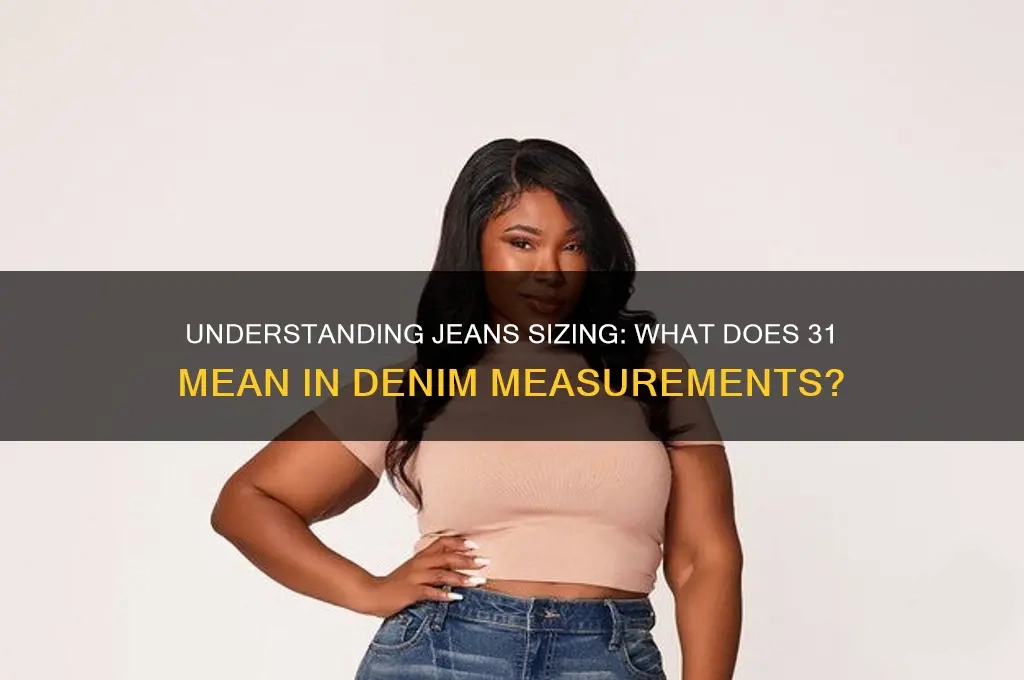
What size is 31 in womens jeans

The term 31 in jeans refers to the waist size of a pair of jeans, measured in inches. It is a standard sizing convention used in the apparel industry to help consumers find the right fit. A 31-inch waist size typically corresponds to a medium or large size, depending on the brand and style of jeans. Understanding this measurement is crucial for anyone looking to purchase jeans that fit comfortably and flatter their body shape. Whether shopping online or in-store, knowing your waist size, such as 31 inches, ensures a more accurate and satisfying shopping experience.
| Characteristics | Values |
|---|---|
| Waist Size | 31 inches (78.74 cm) |
| Type | Typically refers to waist measurement in jeans sizing |
| Fit | Varies by brand (e.g., slim, straight, relaxed) |
| Inseam | Not specified by waist size; depends on style (e.g., 30″, 32″, 34″) |
| Gender | Unisex (used in both men’s and women’s jeans) |
| Common Brands | Levi’s, Wrangler, Diesel, Gap, etc. |
| Size Equivalent | Approx. Medium to Large in men’s jeans; varies in women’s sizing |
| Measurement | Taken around the natural waist or where the jeans sit |
| Stretch | Depends on fabric composition (e.g., cotton, elastane blend) |
| Style | Applicable to various styles (e.g., skinny, bootcut, flared) |

Affixed Cloth Embroidery Denim Jeans
Asymmetrical denim jeans
Original price was: $20.00.$18.30Current price is: $18.30.Baggy denim blue jeans
Original price was: $21.00.$20.60Current price is: $20.60.Baggy denim jeans
Original price was: $18.00.$16.20Current price is: $16.20.



Understanding Jeans Sizing Basics
Jeans sizing can be a maze, especially when numbers like 31 come into play. This number typically refers to the waist measurement in inches, a standard sizing convention in many countries. However, it’s not as straightforward as it seems. A size 31 waist in jeans doesn’t always translate to a 31-inch waist on the wearer due to variations in brand sizing, fabric stretch, and cut. For instance, a pair of slim-fit jeans might fit a 30-inch waist snugly, while a relaxed fit could accommodate a 32-inch waist comfortably, both labeled as size 31. Understanding this nuance is the first step to decoding jeans sizing.
To navigate this complexity, start by measuring your waist accurately. Use a flexible tape measure around the narrowest part of your torso, ensuring it’s parallel to the floor. Add 1–2 inches to this measurement for comfort, especially if you prefer a looser fit. For example, if your waist measures 30 inches, a size 31 might be ideal. However, always refer to the brand’s size chart, as European brands often size smaller than American ones. For instance, a size 31 in Levi’s might differ from a size 31 in Zara. This step-by-step approach minimizes trial and error.
The rise of jeans—low, mid, or high—also impacts fit, even within the same waist size. A size 31 low-rise jean sits below the belly button, offering a modern, casual look, but may feel tighter due to the lower positioning. Conversely, a high-rise size 31 sits at the natural waist, providing more coverage and often a more comfortable fit. Understanding these cuts helps in choosing not just the right size, but the right style for your body type. For petite individuals, a mid-rise size 31 might elongate the legs, while taller frames may prefer high-rise for balance.
Finally, fabric composition plays a silent yet significant role. Jeans with 2–5% elastane or spandex offer stretch, allowing a size 31 to fit waists ranging from 30 to 32 inches comfortably. Rigid denim, on the other hand, has no give, requiring a more precise fit. Always check the material tag: 100% cotton jeans will shrink slightly after the first wash, so consider sizing up if you’re between measurements. For longevity, wash jeans inside out in cold water and air dry to maintain the intended fit. This practical knowledge ensures your size 31 jeans remain a staple in your wardrobe.
Affixed Cloth Embroidery Denim Jeans
Asymmetrical denim jeans
Original price was: $20.00.$18.30Current price is: $18.30.Baggy denim blue jeans
Original price was: $21.00.$20.60Current price is: $20.60.Baggy denim jeans
Original price was: $18.00.$16.20Current price is: $16.20.
Measuring Waist and Inseam for 31
The number 31 in jeans typically refers to the waist measurement, a critical dimension for achieving the perfect fit. However, understanding how to measure your waist and inseam accurately is essential to ensure that a size 31 jean will flatter your body. The waist measurement is taken around the narrowest part of your torso, usually just above the belly button, while the inseam is measured from the crotch to the bottom of the leg. These two measurements are the foundation of a well-fitting pair of jeans.
To measure your waist for a size 31, use a flexible tape measure and wrap it around your natural waistline, ensuring it’s snug but not tight. The tape should be parallel to the floor, and you should be standing upright with your feet shoulder-width apart. For most adults, a waist measurement of 31 inches corresponds to a medium or average build. However, it’s crucial to consider your body shape and the desired fit – whether you prefer a slim, regular, or relaxed style. For instance, if you have a more athletic build with broader hips, you might opt for a size 32 waist with a shorter inseam to maintain a balanced silhouette.
When measuring your inseam, accuracy is key. Wear a pair of well-fitting jeans or trousers and stand with your feet slightly apart. Use a tape measure to determine the length from the crotch seam to the bottom of the leg, where you want the jeans to end. This measurement will help you choose between different inseam lengths, such as 30, 32, or 34 inches, which are commonly paired with a 31-inch waist. Keep in mind that inseam lengths can vary based on height and personal preference – shorter individuals may prefer a 30-inch inseam, while taller individuals might opt for a 34-inch inseam to avoid high-watering.
A common mistake when measuring for size 31 jeans is relying solely on the waist measurement without considering the inseam. This can lead to jeans that fit well around the waist but are either too short or too long. To avoid this, always measure both dimensions and refer to size charts provided by jean manufacturers. Additionally, consider the fabric’s stretch and the desired fit – a pair of jeans with 2% elastane will fit differently than 100% cotton denim. By taking these factors into account, you can confidently select a size 31 jean that complements your body shape and style preferences.
In practice, measuring for a size 31 waist and appropriate inseam is a straightforward process that requires attention to detail. For best results, measure yourself in the morning when your body is least likely to be swollen or bloated. Wear form-fitting clothing or undergarments to ensure accurate measurements. If you’re between sizes, consider trying on multiple pairs to determine the most comfortable fit. Remember, the goal is not just to find a size 31 jean but to discover the perfect combination of waist and inseam measurements that make you feel confident and comfortable. By mastering this process, you’ll be well on your way to building a denim collection that flatters your unique body shape.
Affixed Cloth Embroidery Denim Jeans
Baggy denim blue jeans
Original price was: $21.00.$20.60Current price is: $20.60.Baggy denim jeans
Original price was: $18.00.$16.20Current price is: $16.20.Baggy jean in a dark indigo wash
Original price was: $21.00.$19.30Current price is: $19.30.

Common Brands Offering Size 31
A size 31 in jeans typically refers to the waist measurement in inches, catering to individuals with a slimmer or more athletic build. This size is particularly popular among men, though some women’s brands also offer it for those who prefer a lower-rise, tailored fit. When shopping for size 31 jeans, it’s essential to consider not just the waist but also the brand’s specific fit and cut, as these can vary significantly. Here’s a focused guide on common brands that reliably offer this size.
Levi’s stands out as a go-to brand for size 31 jeans, with their iconic 501 Original Fit and 511 Slim Fit being perennial favorites. Levi’s sizing is consistent across their range, making it easier to find the perfect fit without guesswork. For those seeking durability and timeless style, Levi’s is a safe bet. Pair their jeans with a leather belt to ensure a snug fit, especially if you’re between sizes.
Diesel caters to a more fashion-forward audience with their size 31 offerings, often featuring unique washes and distressed details. Their Thavar and Viker styles are particularly popular for their slim, modern cuts. However, Diesel’s sizing can run slightly smaller, so consider sizing up if you prefer a more relaxed fit. Their jeans are an investment but are known for their premium quality and distinctive aesthetic.
For budget-conscious shoppers, Uniqlo provides size 31 jeans at an accessible price point without compromising on quality. Their Slim Fit and Straight Fit options are versatile and ideal for everyday wear. Uniqlo’s jeans are also available in various lengths, ensuring a tailored look without the need for alterations. Pair them with a basic tee for a casual outfit or dress them up with a blazer for a smarter ensemble.
AG Jeans is another notable brand for size 31, particularly for those who prioritize comfort and stretch. Their Tellis Slim Fit and Graduate Tailored Leg styles are crafted with premium denim that retains its shape over time. AG Jeans is a great choice for individuals with an active lifestyle, as their jeans offer flexibility without sacrificing style. Keep in mind that their sizing can run slightly larger, so trying them on is recommended.
Lastly, Nudie Jeans appeals to eco-conscious consumers with their size 31 options, which are sustainably produced and designed to age beautifully. Their Thin Finn and Grim Tim models are slim-fit classics that develop unique character with wear. Nudie Jeans encourages customers to repair and reuse their denim, making them a long-term investment. For best results, wash their jeans sparingly and air dry to preserve the fabric’s integrity.
In summary, size 31 jeans are widely available across brands, each offering unique fits and styles to suit different preferences. Whether you prioritize affordability, sustainability, or high-end fashion, there’s a brand that aligns with your needs. Always check the brand’s size guide and consider trying on multiple styles to find the perfect fit.
Affixed Cloth Embroidery Denim Jeans
Asymmetrical denim jeans
Original price was: $20.00.$18.30Current price is: $18.30.Baggy denim blue jeans
Original price was: $21.00.$20.60Current price is: $20.60.Baggy denim jeans
Original price was: $18.00.$16.20Current price is: $16.20.
Converting Size 31 to Other Systems
A size 31 in jeans typically refers to the waist measurement in inches, a standard sizing convention in many countries, particularly in the United States. However, jeans sizing can vary significantly across different regions and brands, making conversions essential for international shoppers or those exploring diverse labels. Understanding how to translate a size 31 into other systems ensures a better fit and a more satisfying shopping experience.
Analytical Perspective:
In the European sizing system, a size 31 waist often corresponds to a size 40 or 42, depending on the brand’s cut and fit. For instance, Italian brands like Diesel or Armani may label a 31-inch waist as a 42, while French or German brands might use a 40. This discrepancy arises from differences in body type assumptions and design philosophies. Similarly, in the UK, a size 31 waist might align with a size 12 or 14 in women’s jeans, though this is less common in men’s sizing. Analyzing these variations highlights the importance of checking brand-specific size charts before purchasing.
Instructive Steps:
To convert a size 31 to other systems, follow these steps:
- Measure Accurately: Confirm your waist measurement in inches using a tape measure. A size 31 should correspond to a 31-inch waist, but always double-check.
- Consult Size Charts: Visit the brand’s website or refer to their size guide. For example, Levi’s size 31 in men’s jeans aligns with a 31-inch waist, but their women’s jeans may differ.
- Use Conversion Tools: Online converters can help translate inches to European or Asian sizes. For instance, a size 31 waist is roughly equivalent to a size 40 in Japan.
- Consider Fit: Account for desired fit—slim, regular, or relaxed—as this affects how a size 31 translates across systems.
Comparative Insight:
While a size 31 in the US system is straightforward, Asian sizing often runs smaller. In countries like South Korea or China, a size 31 waist might correspond to a size 29 or 30 due to differences in body proportions and styling preferences. Conversely, in countries with larger average body sizes, such as Australia, a size 31 may align more closely with a size 32 in US measurements. These comparisons underscore the need for regional awareness when shopping internationally.
Practical Tips:
When converting size 31 to other systems, always prioritize fit over the number. For example, if you’re between sizes, opt for the larger one and tailor as needed. Additionally, read customer reviews to gauge whether a brand runs small, true to size, or large. For online purchases, check the return policy to ensure flexibility if the conversion isn’t perfect. Finally, keep a record of your measurements and successful conversions for future reference, streamlining the process across brands and regions.
By mastering these conversions, you’ll navigate the global jeans market with confidence, ensuring a perfect fit every time.
Baggy fit denim jeans
Original price was: $30.00.$26.50Current price is: $26.50.Baggy wide leg denim
Original price was: $22.00.$20.30Current price is: $20.30.Best denim skinny jeans
Original price was: $38.00.$35.60Current price is: $35.60.Black denim ripped jeans
Original price was: $25.00.$23.20Current price is: $23.20.




Tips for Finding the Perfect Fit
A size 31 in jeans typically refers to the waist measurement in inches, a common sizing standard in many countries. However, finding the perfect fit involves more than just knowing your waist size. Here’s how to ensure your jeans not only fit well but also flatter your body.
Understand the Rise and Its Impact
The rise of jeans—low, mid, or high—affects how they sit on your waist and hips. A size 31 waist in low-rise jeans will sit lower on the hips, often requiring a smaller size to avoid gaping at the back. Conversely, high-rise jeans with a 31-inch waist will sit higher on the natural waist, providing more coverage and potentially needing a true-to-size fit. Measure your waist at the narrowest point and your hips at the widest to determine the best rise for your body shape.
Consider Stretch and Fabric Composition
Jeans with stretch (typically 1-3% elastane or spandex) offer more flexibility in sizing. A size 31 in 100% cotton jeans will fit differently than a pair with 2% stretch. Stretch denim conforms to your body over time, so opt for a snug fit initially. For rigid denim, prioritize comfort—a size 31 should allow you to pinch 1-2 inches of fabric at the waist when fastened.
Master the Try-On Technique
When trying on size 31 jeans, perform the “sit and bend” test. Sit down and ensure the waistband doesn’t dig in or feel overly tight. Bend at the knees—the fabric should stretch without restricting movement. Check the thigh area for tightness and the calf for proper tapering. If the jeans feel too snug in any area, size up and consider tailoring for a precise fit.
Know When to Tailor
Even a size 31 might not align perfectly with your unique proportions. Tailoring is key for achieving a flawless fit. Focus on adjusting the waist, inseam, and hem. For example, if the waist fits but the length is off, hemming is a straightforward fix. A skilled tailor can also taper the legs or adjust the rise for a custom fit that off-the-rack jeans rarely provide.
Leverage Brand-Specific Sizing Charts
Size 31 can vary across brands due to differences in cut and vanity sizing. Always consult the brand’s size guide and read customer reviews for insights on fit. For instance, European brands often run smaller, while American brands may offer more room in the thighs. Keep a record of your measurements and compare them to the brand’s specifications to narrow down the best fit.
By focusing on rise, fabric, fit tests, tailoring, and brand-specific details, you’ll transform a generic size 31 into jeans that feel tailor-made for your body.