Don't miss our holiday offer - up to 50% OFF!

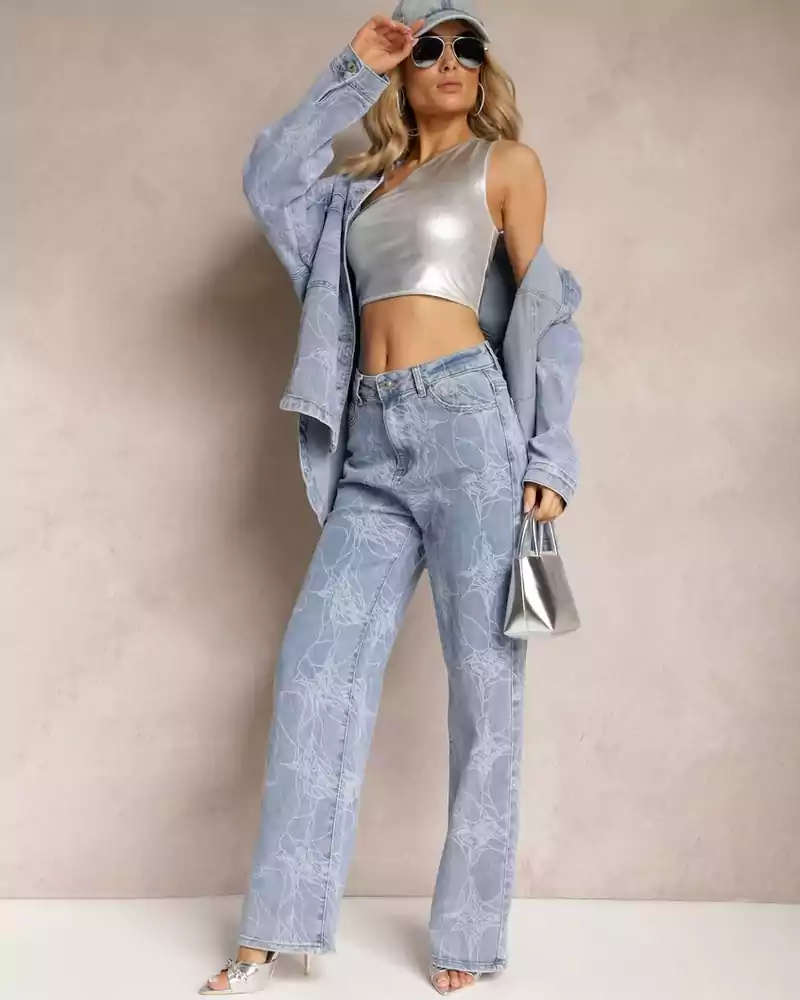
Custom Denim Set: Trusted Custom Denim Set Supplier for Small‑Batch Brand Runs

Introduction: The Ascendancy of the Coordinated Garment
The denim set—a harmonized ensemble of jacket and trousers—represents a distinct sartorial statement that transcends the utilitarian origins of its constituent parts. For the contemporary brand, a custom denim set offers a cohesive aesthetic that communicates a deliberate, curated identity. It is a garment that exists at the intersection of workwear authenticity and high-fashion sensibility. For small-batch brand runs, the sourcing of these coordinated pieces demands a manufacturing partner that combines technical expertise with the flexibility to accommodate modest order volumes. This guide delineates the strategic considerations for navigating this specialized sourcing landscape.
Defining the Denim Set: A Synthesis of Silhouette
The denim set encompasses a spectrum of coordinated apparel, most commonly comprising a jacket and matching pants or jeans. The contemporary market has expanded this definition to include tracksuit-inspired configurations, cargo sets, and even shorts ensembles . These sets offer brands a “complete look” that resonates with consumers seeking a polished, head-to-toe aesthetic. The uniformity of fabric and wash across the jacket and trousers creates a visual cohesion that distinguishes the ensemble from mismatched separates.
The Small-Batch Imperative: The Advantages of Limited Runs
The decision to pursue a small-batch production model is often a strategic one for emerging brands. Limited runs mitigate inventory risk, reduce capital expenditure, and allow for more agile response to market feedback . This approach aligns with the contemporary consumer’s desire for exclusivity and scarcity. A small-batch denim set, produced in quantities as low as 50 to 100 pieces, can generate significant brand cachet without the financial burden of mass production.
The OEM/ODM Spectrum: Defining the Partnership
Understanding the distinction between Original Equipment Manufacturing and Original Design Manufacturing is paramount. In an OEM arrangement, the brand provides the design specifications—the tech pack, measurements, and material requirements—to the manufacturer . In an ODM model, the manufacturer offers pre-existing designs that the brand can adapt and label as its own . For brands with limited design resources, ODM offers a expedited pathway to market, while OEM provides maximal creative control.
The Vertically Integrated Factory: The Infrastructure of Efficiency
The selection of a manufacturing partner is the most consequential decision in the sourcing journey. A vertically integrated factory—one that consolidates weaving, dyeing, finishing, and garment assembly under a single roof—offers a decisive competitive advantage. This integration eliminates the communication lags and quality inconsistencies that plague fragmented supply chains. It permits the manufacturer to maintain rigorous quality control and reduce lead times by an estimated 35 to 50 percent compared to less integrated operations .
The Geography of Sourcing: Guangdong and Beyond
China remains the dominant force in global denim manufacturing, with specific regions offering distinct advantages. Guangdong province, home to major cities like Dongguan and Guangzhou, hosts a dense concentration of vertically integrated factories that specialize in premium finishes such as enzyme washing, laser distressing, and sustainable dyeing techniques . Fujian province, particularly around Xiamen, has emerged as a cost-efficient alternative for mid-tier denim fashion, offering competitive pricing without sacrificing quality standards .
Fabric Selection: The Foundation of Quality
The integrity of a denim set begins with its substrate. The choice of fabric—its weight, composition, and weave—dictates the drape, durability, and capacity for holding a wash. Manufacturers offer a spectrum of options, from midweight 10 oz denim to heavyweight 16 oz fabrics. The composition may be 100% cotton for classic durability and fade potential, or a cotton-polyester blend for enhanced strength and wrinkle resistance. The selection must be aligned with the desired aesthetic and functional requirements of the garment.
The Art of the Wash: A Unified Aesthetic
The wash is the defining attribute of a denim set, and consistency between the jacket and trousers is essential for a cohesive look. The choice of wash—whether stone, enzyme, acid, vintage, or distressed—dictates the character of the ensemble . Manufacturers offer a panoply of finishing techniques, including light wash, heavy wash, and garment-dyeing, which allows color to permeate the entire garment, including seams and ribs, for a dimensional, nuanced finish .
Customization Capabilities: Distinguishing the Set
Customization extends beyond the fabric and wash to the secondary details. Brands can select from a range of hardware finishes—brass, gunmetal, anti-copper—for buttons, zippers, and rivets. Embellishment options include embroidery, screen printing, and the application of custom patches or chenille logos . These details contribute to a cohesive narrative of quality and brand identity, transforming a simple garment into a distinctive brand artifact.
Private Label Services: Branding Integration
A comprehensive manufacturing partner will offer private-label services, allowing a brand to integrate its own labels, tags, and packaging into the final product . This extends to the inclusion of custom woven labels, leather or PU patches, and bespoke hang tags. The unboxing experience, from the poly bag to the custom box, reinforces brand perception and contributes to a premium consumer experience.
Navigating Minimum Order Quantities
For small-batch brands, the Minimum Order Quantity is a critical financial consideration. While mass-market exporters may demand 1,000 pieces or more, many specialized manufacturers offer thresholds as low as 50 to 100 pieces per style and color . Some suppliers even offer MOQs as low as a single piece for stock styles, though custom designs will typically require a higher commitment . Identifying a manufacturer with flexible MOQs is essential for effective cash flow management and risk mitigation.
Sampling: The Crucible of Refinement
Before bulk production, the sampling phase is indispensable. This iterative process involves creating physical prototypes from the brand’s tech pack to evaluate fit, fabric behavior, and wash quality. Manufacturers typically offer sampling lead times of 3 to 7 days for simple designs . The sample is the crucible in which potential issues are identified and rectified, ensuring that the final product aligns with the brand’s vision and quality benchmarks.
Lead Times and Production Planning
The timeline from order placement to delivery is a variable that must be factored into operational planning. Bulk production lead times for custom denim sets typically range from 20 to 35 days following sample approval . This timeline can fluctuate based on the complexity of the wash, the manufacturer’s existing capacity, and shipping logistics. A reliable manufacturing partner will provide transparent timelines and maintain consistent communication throughout the production cycle.
Quality Control: Ensuring Consistency
Maintaining consistency across a production run is a formidable challenge, particularly for coordinated sets where jacket and trousers must share a unified aesthetic. Reputable manufacturers implement rigorous in-line and final quality control checks that measure stitching integrity, hardware placement, wash consistency, and overall fit . This process often involves a multi-point checklist on every piece, ensuring that the quality observed in the sample is replicated across the entire order.
Compliance and Certifications: Verifying Quality
For brands seeking to appeal to a conscientious consumer base, manufacturer certifications are a critical consideration. ISO 9001 indicates adherence to quality management standards, while Oeko-Tex Standard 100 verifies chemical safety. BSCI or SA8000 certification demonstrates a commitment to social compliance and ethical labor practices . Verifying these certifications provides assurance that the production process aligns with international standards.
The Economics of Customization: Pricing Structures
The cost of a custom denim set is determined by a confluence of factors: the quality of the fabric, the complexity of the wash, the type of hardware, and the order volume. A typical small-batch run might cost between $21 and $25 per set for quantities of 100 to 400 pieces . As order volumes increase, the per-unit cost decreases, reflecting economies of scale. Brands must understand this cost structure to manage margins and price their products competitively.
The Communication Imperative: Response Times and Transparency
In a global sourcing environment, communication is the linchpin of a successful partnership. Leading manufacturers maintain response times of under 4 hours, indicating proactive engagement and client focus. A high client retention rate, or reorder rate—often exceeding 25 percent—signals satisfaction and trust among existing buyers . These metrics serve as important indicators of a manufacturer’s reliability and commitment to partnership.
Conclusion: Crafting a Cohesive Identity
The sourcing of a custom denim set for a small-batch brand run is a strategic endeavor that demands a careful selection of a manufacturing partner. By navigating the nuances of fabric selection, wash consistency, and customization capabilities, a brand can create a coordinated garment that communicates a deliberate, curated aesthetic. It is a partnership that extends beyond transaction, requiring a manufacturer that understands the creative vision and possesses the technical acumen to execute it. The result is not merely a matching jacket and trousers, but a statement of identity—a cohesive artifact that embodies the brand’s character and ambition.