Don't miss our holiday offer - up to 50% OFF!

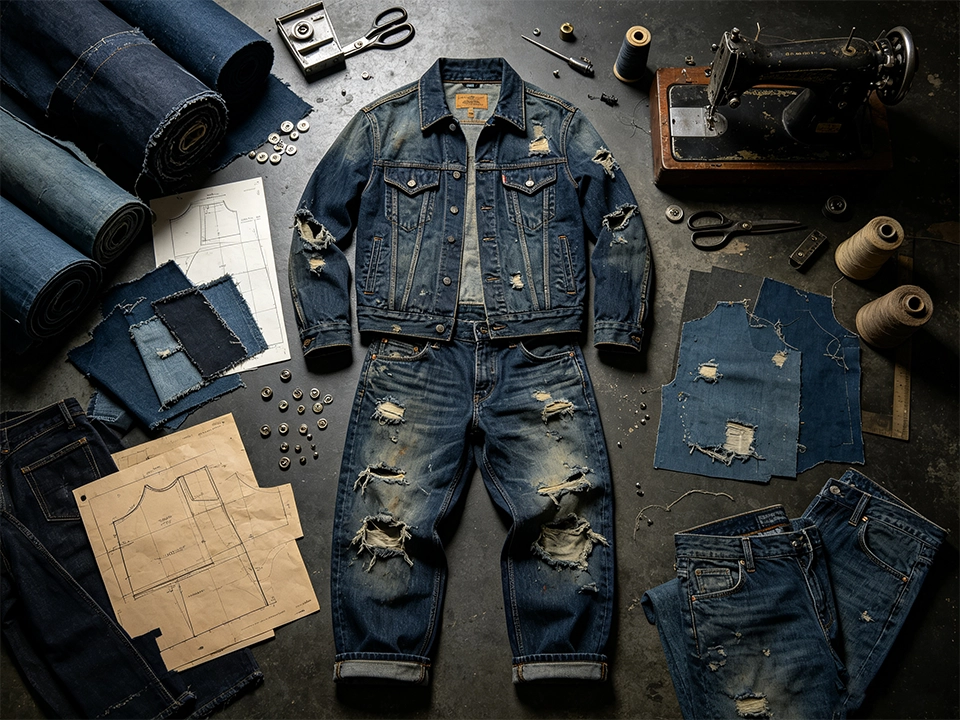
Custom Jacquard Denim Manufacturer: Low MOQ, Fast Turnaround

1. Introduction: The Fabric That Wears Its Design
Most denim is decorated after it is woven. Printed, embroidered, patched — the design arrives as an afterthought on a plain substrate. Jacquard denim reverses the sequence. The pattern is woven into the cloth itself, thread by thread, on a loom that treats the design as part of the fabric’s very architecture. The result is a garment that cannot be unstitched from its identity.
For a brand, the appeal is structural. A jacquard motif is not a layer that can crack, fade, or peel; it is the textile. And in a market saturated with printed replicas, the woven pattern carries a tactile authenticity that photography cannot counterfeit. This guide addresses the practical question that follows the aesthetic one: how does a brand commission custom jacquard denim without a container-sized commitment, and how fast can the process actually run?
2. What Jacquard Denim Actually Is — and Why It Is Different
The jacquard loom, patented in the early nineteenth century, introduced a mechanism that controls each warp thread independently through a sequence of punched cards. Its modern descendants use electronics, but the principle is unchanged: where a standard loom follows a fixed weave pattern, a jacquard head can weave nearly any design — logos, crests, geometric reliefs, continuous textures — directly into the cloth.
Denim itself is a warp-faced twill, and jacquard denim fuses the two technologies. The signature diagonal twill line may dissolve into a motif, reappear as a border, or structure an all-over pattern with weft floats that rise from the surface. Related constructions complicate the taxonomy: a dobby weave offers geometric repeats on a simpler harness, while a dobby-jacquard hybrid splits the difference between texture and freedom . The distinction matters commercially, because pattern freedom and price move in the same direction.
3. The Two-Stage Supply Chain: Mill and Garment Factory
Custom jacquard denim is not one order; it is two, and the buyer who forgets this pays for the lesson twice.
The first stage is the mill, where the yarn is woven into patterned cloth. The second is the garment factory, which cuts, sews, washes, and finishes the jacket or jean. These are separate businesses, often in separate cities, with separate minimums and separate calendars. The mill quotes yards; the factory quotes pieces. The fabric must exist before the garment can be quoted accurately, and the wash that defines the final aesthetic happens after the weave, at the garment stage.
The strategic implication is that a jacquard program is a coordination problem, not a purchase. Some suppliers — vertically integrated denim houses — control both stages under one roof, and for the low-volume buyer they are disproportionately valuable. A single throat to choke, a single schedule to manage, and a single invoice to dispute.
4. The MOQ Question, Answered Honestly
4.1 Fabric Minimums: The Yard Is the Unit
Fabric is where minimums become serious. Jacquard weaving carries a fixed setup cost — the pattern programming, the harness preparation, the trial weaving — and mills amortize it over yardage rather than pieces.
The spectrum is wide. At the flexible end, marketplace mills quote custom-pattern jacquard denim at minimums as low as a single meter or five square yards . At the industrial end, the arithmetic changes abruptly: one specialist states a minimum of 1,000 yards for jacquard due to pattern-setup complexity , and bespoke custom fabric programs elsewhere run from 5,000 to 8,000 yards, softening only to about 1,000 yards per article when the order fills a container .
The lesson is blunt: “low MOQ jacquard” exists, but it lives at the fabric tier, not the tier of true bespoke weaving. The buyer’s real choice is between a stock or semi-stock jacquard base, customized within the mill’s existing range, and a fully proprietary weave, which carries a yardage commitment that only a serious program can justify.
4.2 Garment Minimums: Where Low MOQ Actually Applies
At the garment tier, the minimums are friendlier. Custom denim jacket programs at fifty pieces are now routine, with manufacturers explicitly courting startup brands and small wholesalers at that threshold . Blank-based customization drops to a single piece at some houses .
The reconciliation is strategic. A brand can order a modest quantity of a semi-stock jacquard fabric — enough for a fifty-piece capsule — and build the garment at a low piece minimum. The combination yields a genuinely woven-pattern garment at a run size that a conventional bespoke program would refuse. Low MOQ is real; it is simply assembled from the right tiers.
5. What “Fast Turnaround” Really Requires
5.1 Digital Sampling: The Jacquard Advantage
The same technology that makes jacquard flexible makes it fast. Electronic jacquard heads accept digital pattern files directly — no punched cards, no hand-set harnesses — and modern mills can produce a sample swatch of a new pattern in days rather than weeks. Digital garment development compounds the gain: pattern software such as TUKAcad, Optitex, and CLO 3D allows virtual draping and fit iteration before a single yard is cut .
The consequence is a sampling cycle that defies the industry’s old reputation. Manufacturers in the custom denim space now quote first samples within seven days, covering pattern development, cutting, sewing, and decoration . The mill’s sampling stage remains non-negotiable — the buyer signs off on the actual woven fabric before it scales — but it is a week of waiting, not a season.
5.2 The Realistic Timeline: From Sample to Shelf
Speed, honestly stated, is a matter of stages. Pattern grading takes days; a typical CAD-driven grading run from S to 3XL completes in roughly three working days with tolerances held near half a centimeter . Sample production runs a week. Bulk production of custom denim jackets typically occupies twenty-five to thirty-five days, with inspection, packaging, and shipping adding ten to twenty days more depending on destination and freight method .
The honest aggregate is six to ten weeks from approved sample to delivered goods — faster than the industry’s four-to-eight-week sampling norm alone used to suggest . “Fast” does not mean immediate; it means predictable, compressible at the margins, and no longer the industry’s chronic embarrassment.
6. The Pattern File: The Heart of the Order
The jacquard pattern is the soul of the product, and it travels as data. The buyer’s responsibility is to deliver a pattern file the mill can read — a high-resolution design in the correct format, with the repeat size stated, the scale declared, and the intended motif resolution matched to the yarn count.
Three specifications matter above all. The repeat size, typically measured in inches or centimeters, determines how the pattern tiles across the fabric’s width and length. The yarn count and weight set the practical resolution of the motif — fine, dense yarns render intricate detail that coarse yarns blur. And the warp construction determines whether the pattern reads in the indigo warp face, the weft, or a balanced blend of both. A design that ignores these constraints will arrive at the loom as a disappointment, because the loom is merciless with ambiguity.
The professional move is to request the mill’s pattern template before commissioning artwork. Mills that provide a file specification, and a sample card of their achievable repeat structures, convert guesswork into specification. The template is the contract.
7. Price Drivers of Custom Jacquard Denim
7.1 Pattern Complexity and Repeat Size
The loom prices freedom. A simple geometric repeat on a constrained harness is cheap to program and fast to weave; a complex, large-repeat artistic motif consumes loom time and pattern memory at a different rate. Complexity is the first driver, and the mill will quote accordingly — which is why the same mill’s jacquard minimums and prices both scale with ambition .
7.2 Yarn, Weight, and Warp Construction
The second driver is the fabric’s physical specification. Weight — the GSM or ounce figure — sets the cost of yarn per meter. Long-staple cotton costs more and delivers the smooth surface that makes motifs read crisply. Elastane content, blend ratios, and the depth of the indigo or overdye treatment each add their increment. A 10-ounce jacquard in ring-spun cotton is a different product, and a different price, from a 5-ounce novelty shirting weight .
7.3 The Wash After the Weave
The third driver arrives after the loom. The garment wash — enzyme, stone, overdye, laser, or ozone — reshapes the color, hand, and relief of the woven pattern. A raised motif that reads clearly on greige cloth can recede into the surface after a heavy stone wash; a subtle texture can be transformed by a soft enzyme rinse. Specify the wash against the pattern, not in isolation, and verify the interaction on the sample. The weave and the wash are collaborators, and the price list prices both.
8. How to Vet a Jacquard Specialist
Not every “jacquard denim” supplier actually weaves. The category attracts trading companies that buy standard cloth and relabel it, and the distinction is discoverable with three questions.
First: does the mill run jacquard looms in-house, and how many? A genuine specialist describes its own machinery; a trader describes its catalogue. Second: will it provide a woven sample of your pattern before production, not merely a stock swatch? The answer separates the mill from the middleman . Third: can it state the pattern-file format, the repeat template, and the setup cost in writing? A mill that specifies its process is a mill that controls it. Regional concentration is a useful heuristic — the jacquard denim specialists of Foshan, Guangdong, have built a generation of expertise in exactly this weave — but capability, not geography, is the test.
9. The Low-MOQ, Fast-Turnaround Strategy
The strategy for the small brand is a ladder of deliberate choices, each converting a constraint into an advantage.
Begin with the fabric tier. Select a semi-stock jacquard base — a pattern within the mill’s existing range — rather than commissioning a proprietary weave. The minimum collapses, and the mill’s established program removes the setup risk. Second, pair that fabric with a garment program at a low piece minimum, fifty pieces where available . Third, exploit the digital sampling cycle: iterate the pattern and the fit virtually, then approve a physical sample within a week, and freeze it as the reference.
The sequence is the point. Low MOQ is not a single number but a route — through the mill’s stock range, through the factory’s small-run program, through the digital sample. Brands that understand the route treat “low MOQ, fast turnaround” not as a promise from a supplier but as a discipline of their own.
10. The Price Terrain for Custom Jacquard Denim
The economics of jacquard denim are more approachable than the technology suggests. The fabric itself is competitively priced at the commodity tier: herringbone and patterned jacquard denim fabrics list from roughly US$2.67 to US$2.96 per meter at minimal order quantities on Alibaba , with customizable medium-weight options quoted near US$1.95–2.09 per meter . Specialty constructions — jacquard-effect cotton-spandex blends — run higher, around US$2.90 per meter at mill-scale minimums .
| Tier | Indicative MOQ | Indicative Price |
|---|---|---|
| Custom-pattern jacquard, marketplace tier | 1–5 yards/meters | US$1.95 – US$3.00 / meter |
| Specialty blend jacquard (cotton-spandex) | 1,000 meters | US$2.90 / meter |
| Bespoke proprietary weave | 1,000 – 8,000 yards | Quoted per program |
The garment, not the fabric, carries the larger cost. A custom denim jacket built on such cloth inherits the jacket’s own economics — the fifty-piece programs and the twenty-five-to-thirty-five-day production cycles already described. The strategic insight is that jacquard’s premium is concentrated in the fabric tier, where it is surprisingly modest, and the garment tier, where the low-MOQ market has already done the work of making scale unnecessary.
11. Conclusion: Pattern as Identity
Custom jacquard denim is the rare textile that can carry a brand’s identity in its very structure. It cannot be peeled, reprinted, or replicated by a faster competitor with a printer. And the modern supply chain has removed the two historical objections to commissioning it: the minimums have fallen to the fifty-piece garment tier and the single-yard fabric tier, and the turnaround has collapsed from seasons to weeks.
The discipline is the same as every serious sourcing exercise: know the two-stage chain, choose the tier that matches your ambition, deliver a pattern file the loom can honor, and freeze the sample as the contract. The mills of Foshan and the flexible garment factories of the custom-denim corridor have made the product accessible .
A woven pattern is a commitment, and commitments reward those who make them deliberately. Commission the fabric. Build the garment at a run you can sell. And let the loom do the talking — it will outlast every trend that tries to cover it.