Don't miss our holiday offer - up to 50% OFF!

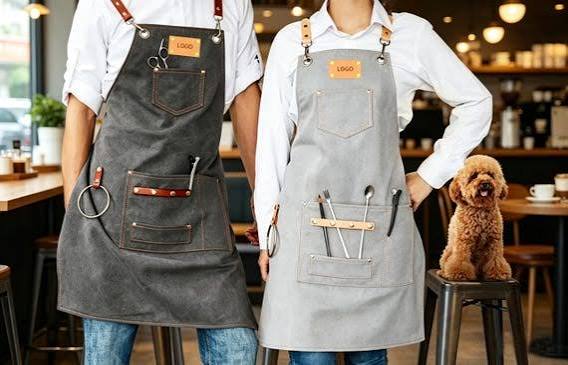
custom logo bbq restaurant beauty salon barista cafe coffee shop bakery denim canvas chef kitchen apron with leather strap

Introduction: The Apron as a Canvas of Professional Identity
The apron has transcended its origins as a mere protective garment. It is now a statement of professional identity, a mobile billboard for the brand, and a tactile artifact that customers remember. In the contemporary hospitality landscape, the apron is often the uniform—the piece that distinguishes the barista from the customer, the chef from the diner, the stylist from the client. The custom denim canvas apron with leather straps represents the apogee of this evolution. It is at once rugged and refined, utilitarian and expressive, a garment that serves its wearer while projecting the brand’s values to the world.
The Material Foundation: Denim and Canvas as Substrates
Denim: Heritage, Durability, and Visual Character
Denim possesses a storied provenance in workwear. Its twill weave, characterized by diagonal ribbing, confers exceptional resistance to tearing and abrasion. For front-of-house applications in cafés, casual dining establishments, and specialty coffee shops, denim offers a distinctive visual character—a heritage aesthetic that signals authenticity and craftsmanship . The fabric softens with washing, developing a patina that records the wearer’s movements. Unlike synthetic alternatives, denim breathes, allowing comfort during long shifts.
The weight of the denim is consequential. Midweight denims—10 to 12 ounces—offer a balance of durability and drape suitable for aprons. Heavier denims provide greater protection but may be stiff and uncomfortable for extended wear. The choice must be calibrated to the demands of the specific application.
Canvas: Weight, Texture, and Workwear Provenance
Canvas, a plain-weave fabric typically composed of cotton or cotton blends, offers a different aesthetic register. It is smoother than denim, with a tighter weave that resists penetration by liquids and particulate matter. Sixteen-ounce canvas is the standard for premium hospitality aprons, offering substantial body and protection . Waxed canvas introduces an additional layer of water resistance and a distinctive rugged appearance that develops a patina over time .
For kitchens, bakeries, and BBQ establishments where stains and splashes are inevitable, canvas provides a practical advantage. Its tighter weave and heavier construction render it more resistant to the ingress of oils and sauces.
Comparative Analysis: When to Choose Which
The selection between denim and canvas is not merely aesthetic. Denim’s heritage character suits front-of-house environments where visual identity is paramount: coffee shops, casual dining, boutique retail. Canvas, particularly in its heavier weights, excels in back-of-house and high-mess applications where protection and durability are the primary considerations. Many venues operate both: canvas for the kitchen, denim for the floor .
The Leather Strap: Functional Elegance and Longevity
Genuine Leather Versus Leather-Look Alternatives
The leather strap is a defining feature of the premium apron. Genuine leather straps offer superior durability, conforming to the wearer’s body over time and developing a distinctive patina. Full-grain leather, the strongest cut of the hide, represents the apex of quality . Vegetable-tanned leather, preserved through natural processes, offers a more environmentally benign alternative to chrome-tanned hides .
Leather-look alternatives—polyurethane or other synthetic materials—offer a more accessible price point but lack the durability and tactile quality of genuine leather. For brands seeking to signal premium positioning, genuine leather is the appropriate choice.
Cross-Back Versus Neck-Loop Configurations
The cross-back strap configuration has emerged as the ergonomic standard for professional aprons. By crossing at the back, the straps distribute the weight of the apron across the shoulders rather than concentrating it on the neck. This design alleviates the neck strain that afflicts wearers of traditional neck-loop aprons during long shifts . The cross-back design also allows for adjustment across a range of body types, accommodating wearers from S to XL with a single configuration .
Neck-loop aprons, while simpler to don and doff, are better suited to short-duration wear or applications where the apron is removed frequently.
Hardware: Brass, Nickel, and Gunmetal Finishes
The hardware of the apron—buckles, rivets, grommets, and snaps—contributes both to functionality and aesthetic coherence. Solid brass offers a classic, warm finish that ages gracefully. Brushed nickel provides a contemporary, industrial appearance. Gunmetal and matte black finishes suit darker colorways and more understated branding . The hardware must be robust enough to withstand repeated adjustment and the rigors of daily use.
The Sector-Specific Applications
BBQ Restaurant: Heat, Stains, and the Theater of Fire
The BBQ apron must contend with a uniquely hostile environment: open flame, flying sparks, grease splatter, and the occasional exuberant gesture over a grill. Denim and heavy canvas offer superior protection compared to lighter fabrics. The apron may be worn by pitmasters and grill cooks who are, in a sense, performers—the apron is part of the show. Custom branding, whether embroidered or applied as a leather patch, reinforces the establishment’s identity in photographs and social media content .
Leather aprons, while less common for BBQ than canvas or denim, offer exceptional heat resistance and a rugged aesthetic that aligns with the craft of barbecue .
Beauty Salon: Precision, Cleanliness, and Client-Facing Aesthetics
In the salon environment, the apron serves a dual purpose: protecting the stylist’s clothing from dyes, chemicals, and water, and projecting an image of professionalism and style. Denim aprons have gained traction in salon settings for their contemporary, approachable aesthetic . The apron must accommodate the tools of the trade—scissors, combs, clips—through thoughtfully designed pockets. The leather strap adds a note of premium quality that clients notice .
For barbershops, the apron is an essential component of the visual identity. The barber’s apron is part of the ritual of the shave, and its materials and construction contribute to the client’s perception of craftsmanship.
Barista and Café: Speed, Spills, and the Third Place
The barista apron is a garment of constant motion. It must accommodate the rapid movements of espresso preparation, milk steaming, and customer service. The apron should be light enough to permit mobility but substantial enough to protect against coffee splashes and milk spills. Denim and canvas both serve well in this context, with denim offering a more fashion-forward appearance that aligns with the aesthetic of specialty coffee culture .
Pocket design is critical: a towel loop is essential for the barista who constantly wipes the steam wand and counter. A pocket for pens, order pads, or a small notebook enhances efficiency.
Bakery and Kitchen: Flour, Heat, and the Rhythm of Service
The bakery and kitchen apron must withstand flour dust, oven heat, and the constant motion of production. Canvas, particularly in heavier weights, offers superior protection against heat and stains. The apron should be long enough to protect the legs from spills but not so long as to present a tripping hazard. Cross-back straps are essential for the long shifts typical of professional kitchens .
For the pastry chef, a lighter apron may suffice, prioritizing mobility over heavy protection. For the line cook, a heavier canvas or denim apron provides necessary defense against splattering oils and boiling liquids.
Custom Logo Application: Methods and Considerations
Embroidery: Durability and Dimensional Texture
Embroidery is the preferred branding method for premium aprons. The process stitches the logo or design into the fabric with thread, creating a raised, tactile finish that reads as quality and permanence. Unlike printing, embroidery does not fade or crack; it is integrated into the garment’s construction. For denim and canvas aprons, embroidery is particularly effective—the thread creates a pleasing contrast against the fabric’s texture .
The logo should be digitized for the specific fabric and placement. Complex designs with fine detail may require simplification for embroidery, as the medium cannot reproduce gradients or very small text. A left-chest placement is standard for logos; larger designs may be placed on the bib or back.
Screen Printing: Vibrancy and Volume Economics
Screen printing offers a more economical alternative for larger orders or designs with multiple colors. The process deposits ink through a mesh screen, producing a flat, vibrant graphic. For aprons intended for promotional distribution or high-volume uniform programs, screen printing provides a cost-effective branding solution . The print’s durability is inferior to embroidery, but for applications where the apron is replaced frequently or the branding is less permanent, it may be appropriate.
Leather Debossing and Engraving: Premium Branding
For aprons featuring leather components—straps, pockets, or patches—debossing and engraving offer a distinctive branding method. Debossing imprints the logo or initials into the leather surface using a heated die, creating a subtle, refined mark . Laser engraving removes material to create a deeper, more permanent impression . Both methods are well-suited to logos with clean lines and simple forms. A removable leather patch, attached with snaps or magnetic fasteners, allows the branding to be changed or removed as needed .
The Production Pathway: Sourcing and Specification
Minimum Order Quantities and Flexible Sourcing
The MOQ landscape for custom aprons varies widely. Domestic decorators may accommodate orders as low as 10 to 25 pieces for embroidered aprons . Overseas manufacturers, particularly those in China and Pakistan, offer lower per-unit costs but impose higher minimums—typically 50 to 200 pieces depending on the supplier and the complexity of the specification . For brands testing a new design or outfitting a single venue, domestic sourcing may be more practical. For larger chains or promotional programs, overseas manufacturing offers significant cost advantages.
The Tech Pack and Sampling Protocol
The Tech Pack for a custom apron must specify the fabric type and weight, the dimensions of the bib and waist, the pocket configuration, the strap style and material, the hardware finish, and the logo placement and method. The sampling process involves the creation of a pre-production sample that incorporates all specifications. This sample is evaluated for fit, construction quality, and branding accuracy. Revisions may be required before bulk production commences.
Fabric and Hardware Sourcing
The denim or canvas selected for the apron must be compatible with the intended use. Pre-shrunk fabrics minimize dimensional changes during washing. Colorfast dyes prevent bleeding onto the wearer’s clothing. The hardware—buckles, rivets, and snaps—must be selected for durability and aesthetic coherence with the fabric and branding.
Quality Assurance for Custom Aprons
Stitch Integrity and Stress-Point Reinforcement
The apron is subjected to significant stress at the points where the straps attach to the body and where the pockets bear weight. Bar tacks, rivets, or reinforced stitching at these points prevent seam failure. The stitching throughout the apron should be consistent and tight, with no loose threads or skipped stitches.
Leather Strap Durability and Attachment Security
The leather straps must be securely attached to the apron body. The attachment method—whether stitched, riveted, or a combination—must withstand the repeated tension of donning and doffing the apron. The straps should be supple enough to conform to the wearer’s body but sturdy enough to bear the apron’s weight without stretching.
Colorfastness and Washability Testing
Denim and canvas are prone to crocking—the transfer of dye to other surfaces—particularly when new. The apron should be tested for colorfastness, especially if it will be washed frequently. The care instructions should specify the appropriate washing method and temperature. Leather straps, if not removable, may require special care; removable straps simplify washing and extend the apron’s lifespan .
Conclusion: The Strategic Value of the Custom Denim Canvas Apron
The custom denim canvas apron with leather straps is more than a protective garment. It is a strategic asset for hospitality and service brands. It protects the wearer while projecting the brand’s identity to every customer who enters the establishment. It is a tactile artifact that customers remember—the barista’s apron in a photograph, the pitmaster’s apron in a video, the stylist’s apron reflected in the mirror. The materials—denim, canvas, leather—convey values of durability, craftsmanship, and authenticity. The custom logo, whether embroidered, printed, or debossed, ensures that every interaction reinforces the brand. For venues seeking a uniform that is at once practical and expressive, the custom denim canvas apron with leather straps offers a compelling proposition.