Don't miss our holiday offer - up to 50% OFF!

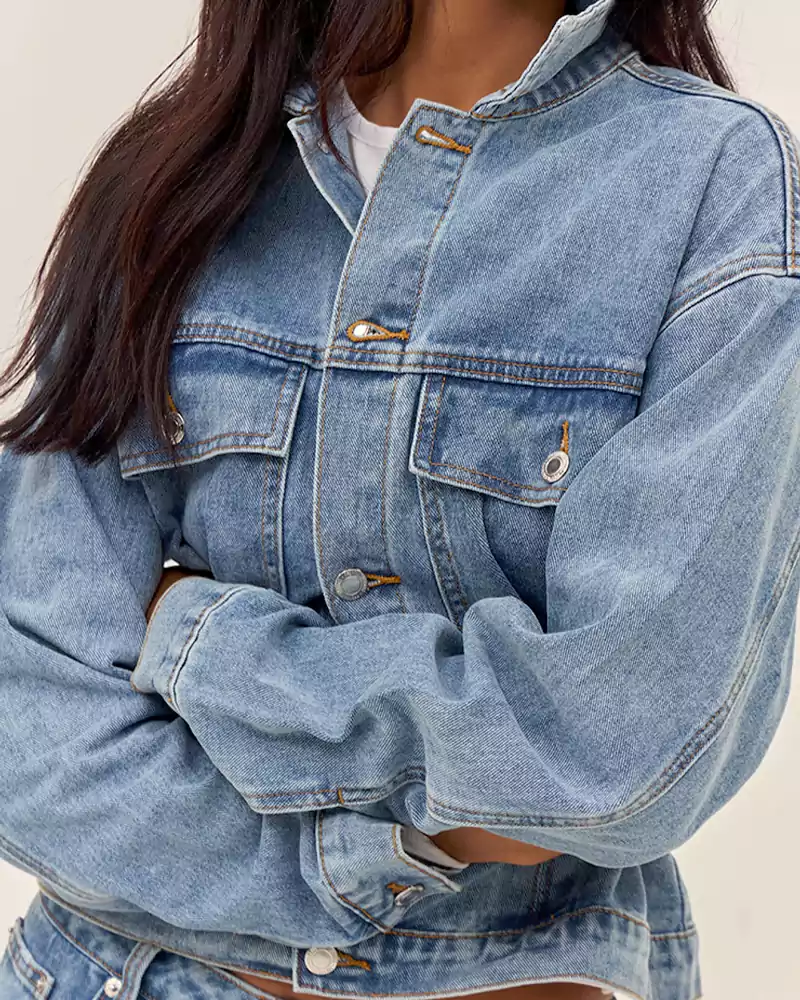
Custom Oversized Fit Denim Jacket | Bulk Production for Fashion Labels

Elevate your streetwear collection with custom oversized fit denim jackets manufactured exclusively for fashion labels. Our bulk production service delivers roomy, on‑trend oversized silhouettes tailored to your brand’s vision, from fabric weight selection and custom washes to hardware, embroidery, screen printing and private‑label tags. We support sampling prior to mass run, strict quality control and flexible MOQ for emerging and established fashion labels alike. Whether you aim for vintage faded, raw denim or heavy‑weight finishes, our cut‑sew OEM capability turns your design sketches into market‑ready oversized denim jackets ready for retail, wholesale or direct‑to‑consumer sales.
Introduction: The Supremacy of Silhouette in Contemporary Fashion
In the dynamic panorama of contemporary fashion, few garments command the enduring ubiquity of the denim jacket. However, the current zeitgeist has witnessed a dramatic departure from the traditional, body-conscious fits that once dominated the market. The ascendance of streetwear and its intersection with high fashion has heralded the era of the oversized fit. For fashion labels aiming to resonate with a discerning consumer base, the provision of a meticulously crafted oversized denim jacket is not merely an option; it is a requisite. This necessitates a strategic partnership with a manufacturer possessing the technical acumen to execute bulk production without compromising the garment’s intended voluminous aesthetic. The transition from a standard pattern to a luxuriously oversized silhouette requires a profound understanding of fabric drape, structural engineering, and precise grading.
Deconstructing the Oversized Denim Jacket Phenomenon
The appeal of the oversized denim jacket transcends mere sartorial comfort; it represents a sartorial statement rooted in notions of nonchalance and effortless style. It draws heavily from the archival workwear silhouettes of the 1990s, recontextualized for a modern audience that values versatility and exaggerated proportion. This trend is particularly potent within the streetwear sector, where fit serves as a primary differentiator from mainstream apparel . A well-executed oversized jacket serves as a canvas for further customization, allowing designers to experiment with washes, distressing, and embellishments without overwhelming the garment’s fundamental structure. It provides the wearer with a sense of ease and volume that is both visually striking and pragmatically functional for layering.
Beyond the “Boxy” Fit: The Technical Definition of Oversized
It is a common misapprehension to conflate an “oversized” fit with a simple increase in dimensions. A truly superior oversized fit—particularly for bulk production—requires a nuanced recalibration of the entire pattern block. It is not merely about a wider chest or longer sleeves; it demands an analysis of the drop shoulder, the depth of the armhole, the width of the bicep, and the overall body length. The balance between a dropped shoulder and a maintained silhouette is delicate; if executed poorly, the jacket can appear slovenly rather than fashionably relaxed. A skilled manufacturer will manipulate the cut to ensure that while the fit is voluminous, the jacket still retains a structural integrity that allows it to fall correctly on the body, avoiding an undesirable parachute effect .
The Cruciality of Pattern Engineering for Proportional Volume
The pattern-making stage is where the “oversized” concept is meticulously translated into a tangible blueprint for manufacturing. This is a sophisticated exercise in proportions and negative ease . The pattern maker must account for the fabric’s weight and shrinkage to predict how the jacket will behave when worn. For oversized jackets, achieving stable shoulder and chest control is paramount . The grading process—creating the pattern for different sizes—must be carefully managed to ensure that the oversized proportion is maintained consistently from a size S to an XXL. Automated cutting machines can be employed to ensure accuracy, but they rely on a pattern that has been meticulously engineered for both fit and fabric yield .
Selecting the Appropriate Denim Fabric Weight and Composition
The choice of fabric is axiomatic to the success of the oversized denim jacket. A lightweight denim will lack the necessary heft to hold an exaggerated shape, collapsing into unsightly folds. Conversely, an excessively heavy fabric can result in a garment that is stiff and unwearable. For oversized silhouettes, a medium to heavyweight denim, typically ranging from 10 to 14 ounces, is often selected . The composition—whether 100% cotton for a rigid, vintage feel or a cotton-polyester blend for stretch and recovery—also plays a critical role. For brands seeking to appeal to the eco-conscious consumer, options such as organic cotton or recycled denim blends are increasingly available, offering a sustainable alternative without compromising on quality .
Navigating the Spectrum of Denim Wash and Finish Development
The wash of a denim jacket is arguably its most defining characteristic, significantly influencing its aesthetic and tactile appeal. In the realm of oversized jackets, the wash often serves to enhance the garment’s volume and texture. Common treatments include enzyme washing for a soft hand feel, stone washing for a faded, lived-in look, and acid washing for a more radical, vintage effect . The development of a signature wash is a collaborative process involving the manufacturer and the brand. It requires meticulous sampling to achieve the precise shade, contrast, and fading patterns that align with the brand’s visual identity . Consistency in wash application across a bulk order is a hallmark of a competent manufacturer .
The Art of Distressing: Achieving Authenticity at Scale
Distressing is a sophisticated craft that, when executed with precision, imparts an invaluable sense of history and authenticity to a denim garment. This can range from subtle whiskering and fading at pressure points to more overt sanding, rips, and fraying . In bulk production, distressing cannot be a haphazard process; it must be controlled and replicable. Industrial techniques such as hand-sanding and laser fading are employed to create specific wear patterns that mimic natural abrasion . For an oversized fit, distressing often focuses on areas such as the collar, cuffs, and hems, as well as the knees and thigh area if the jacket is worn in an elongated style.
Hardware as the “Jewelry” of the Jacket: Customization Options
The hardware—buttons, rivets, zippers, and snaps—serves as the “jewelry” of the denim jacket, providing a significant opportunity for brand differentiation. For a premium label, standard, off-the-shelf hardware is an unacceptable compromise. Customization options abound, including shank buttons that can be embossed with the brand logo, specialized zippers, and rust-proof metal rivets . The finish of the hardware—whether it is antique brass, polished silver, or matte black—should complement the overall aesthetic of the jacket . A high-quality manufacturer will offer sourcing for a wide range of custom hardware to ensure that every element of the garment feels bespoke and cohesive.
The Imperative of Private Labeling for Brand Equity
In an intensely competitive market, a garment’s identity is solidified through its branding. Private labeling transforms a generic jacket into a brand asset. This encompasses everything from the woven neck labels and custom-printed pocket bags to the iconic back patch . Materials for patches range from genuine top-grain leather to sustainable Jacron (recycled paper), offering diverse tactile and aesthetic options . The placement and quality of these labels are a direct reflection of the brand’s attention to detail. Through seamless integration of private label elements, a manufacturer helps build tangible brand equity and consumer loyalty .
The Technical Tech Pack: The Blueprint for Bulk Success
The tech pack is the executive summary of a garment’s design, serving as the definitive document for the manufacturer. For an oversized denim jacket, it must include all essential technical specifications: detailed flat sketches, a graded size chart, a bill of materials (fabric, lining, thread, hardware), and a description of all washes and finishes . This document is the primary tool for communication, ensuring that there is no ambiguity regarding the design intent or construction standards. A comprehensive tech pack is the cornerstone of a smooth production process, minimizing errors and facilitating accurate quoting and sampling.
The Pre-Production Sample: The Litmus Test for Quality
Before a manufacturer can be entrusted with a bulk order, a pre-production sample (or PP sample) is an indispensable requirement . This sample is the physical manifestation of the approved tech pack and wash standard. It allows the brand to see and feel the garment, assessing its fit, fabric hand, wash consistency, and overall workmanship. It serves as the golden standard against which the entire bulk production will be measured. Once the PP sample is formally approved, it acts as the critical “control” to ensure that the quality of the final order is consistent with the original design vision .
Low Minimum Order Quantities (MOQs): A Strategic Imperative for Emerging Brands
For many emerging fashion labels, the prospect of placing a massive bulk order can be financially prohibitive. Recognizing this, many progressive manufacturers now offer flexible low Minimum Order Quantities (MOQs) . This strategic approach allows brands to test new silhouettes, washes, or designs without the risk of overstocking . A low MOQ, sometimes starting as low as 50 pieces per style, serves as a gateway, enabling nascent streetwear and luxury labels to launch their collections with a professional product . This flexibility is crucial for fostering innovation and supporting the next generation of designers.
Scaling Production: Maintaining Consistency Across Bulk Orders
While low MOQs offer flexibility, the ultimate goal for a thriving brand is to scale production. The ability to move seamlessly from small-batch sampling to high-volume bulk manufacturing without sacrificing quality is a primary criterion for selecting a manufacturing partner. This requires a factory with robust production lines, a skilled workforce, and a well-established quality control system . Consistency in cutting, sewing, washing, and finishing across thousands of units is a complex logistical achievement that separates a true industry partner from a simple supplier. The manufacturer must adhere to the approved sample as the immutable standard.
Quality Control Protocols in Denim Jacket Manufacturing
Quality control (QC) is the bedrock of any reputable manufacturing operation, particularly in the detail-oriented world of denim. A stringent QC protocol involves multiple inspection points, from the raw fabric stage through to finished goods. This includes in-line checks during the sewing process, a thorough final inspection of the finished garment, and often, a mandatory third-party inspection by companies like ASAHI LINK to verify standards for international markets . Inspectors will scrutinize measurements, stitching integrity, wash consistency, hardware attachment, and the presence of any defects. This rigorous process ensures that the final product delivered to the brand meets both safety and performance standards.
The Logistics of Global Fulfillment and Shipping
The manufacturing process does not conclude with the quality check; it culminates in the efficient and safe delivery of the finished goods to the brand’s destination. A competent manufacturing partner will have a robust logistics infrastructure in place, handling all aspects of export documentation—commercial invoices, packing lists, and certificates of origin . Options for shipping include cost-effective sea freight and expedited air freight for time-sensitive orders. The goods must be packed professionally in polybags and export-ready cartons to withstand the rigors of transit, ensuring that the jackets arrive in pristine, sellable condition .
Ethical Manufacturing and Sustainable Denim Options
Modern consumers are increasingly discerning about the provenance of their clothing, placing a premium on ethical and sustainable manufacturing practices. Fashion labels must therefore ensure their supply chain aligns with these values. Progressive factories are adopting sustainable practices, including the use of eco-friendly dyes, water-saving wash techniques, and responsible sourcing of fabrics . Certifications such as OEKO-TEX ensure that the fabrics are free from harmful substances. By partnering with a manufacturer committed to these principles, a brand can authentically communicate its dedication to ethical production, which is a powerful tool for building trust and loyalty.
Cost Engineering: Understanding the Factors Affecting Bulk Pricing
Demystifying the cost structure of a custom denim jacket is crucial for effective brand management. The final price per unit is determined by a confluence of factors, including the quality and weight of the denim, the complexity of the wash, the number of custom hardware elements, and the intricacy of the pattern . The scale of the order also plays a significant role; as volume increases, the cost per unit generally decreases due to economies of scale in material sourcing and production efficiency . The choice of shipping method and the complexity of the packaging also contribute to the landed cost.
Case Study: Successful Streetwear Brand Collaborations
The efficacy of a manufacturing partnership is best illustrated through successful collaborations. Many factories have served as the unseen engine behind streetwear brands that have achieved significant market penetration. These partnerships are characterized by open communication, shared product vision, and a mutual commitment to quality. For example, a manufacturer might work with a brand to develop a complex custom print or a challenging oversized silhouette, facilitating the brand’s ability to execute its creative vision and solidify its position in the marketplace .
Conclusion: Partnering with a Manufacturer for Long-Term Growth
The journey from a design concept to a finished, market-ready oversized denim jacket is a complex and multifaceted process. For a fashion label, the choice of a manufacturing partner is arguably the most critical strategic decision it will make. The ideal partner is not just a supplier of labor, but a collaborator who offers expertise in pattern engineering, fabric sourcing, wash development, and quality control. By fostering a long-term partnership with a manufacturer that values transparency, quality, and flexibility, a brand can navigate the complexities of the fashion industry, ensuring its vision is realized with integrity and excellence, thereby securing its trajectory for sustained growth and market relevance.