Don't miss our holiday offer - up to 50% OFF!

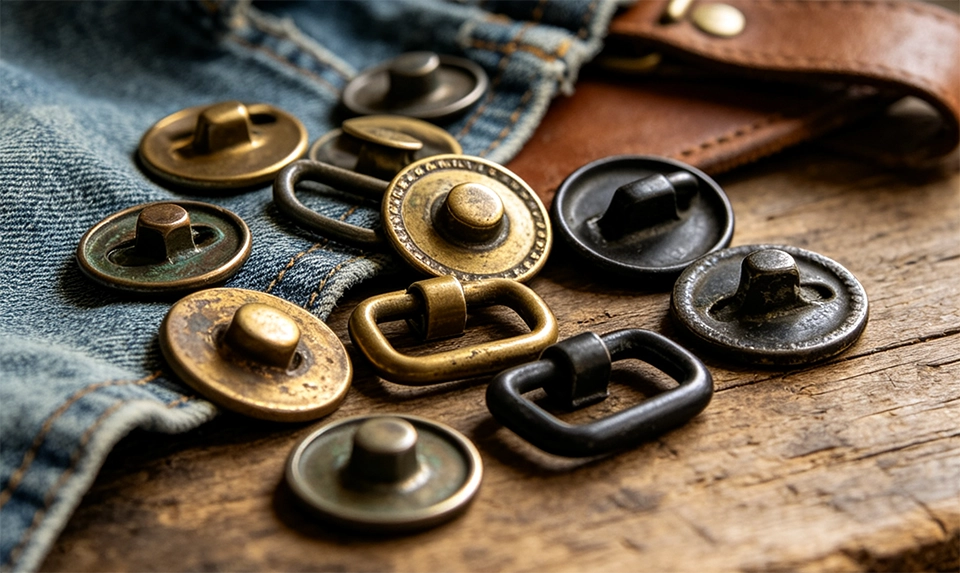
Denim button custom logo metal jeans buttons

1. Overview of Custom Logo Metal Jeans Buttons
1.1 Defining Custom Metallic Denim Fastener Components
Custom logo metal jeans buttons are precision-engineered metallic fasteners purpose-built for integration within denim textile architecture. Unlike generic plastic or unmarked metal hardware, these bespoke components feature brand-specific iconography, typographic insignia, or proprietary motifs embossed, engraved, or etched directly onto their superficial plane. They serve as integral structural fasteners for denim fly closures, waistband fixation, and garment structural anchoring. They also function as subtle tactile branding elements embedded within apparel construction.
Each custom button is engineered to accommodate denim’s dense twill weave, rigid fiber composition, and repeated mechanical flexion during wear. The synergistic fusion of structural functionality and customizable aesthetic rendering distinguishes these components as specialized textile hardware, rather than generic consumer fasteners. Their dual-purpose design redefines incidental garment hardware into intentional brand collateral.
1.2 Market Significance of Branded Denim Hardware Embellishment
The global denim apparel sector has transitioned beyond fabric and silhouette differentiation to granular hardware customization as a core brand stratagem. Mass-market homogenization has diminished the distinctiveness of standard denim construction. Brands now leverage micro-hardware branding to establish tactile product exclusivity and elevated perceived value. Custom logo metal buttons have become a ubiquitous yet understated hallmark of premium denim craftsmanship across luxury, contemporary, and streetwear verticals.
This niche customization segment continues exponential annual growth. It caters to brands seeking holistic design cohesion across every garment component. Discerning consumers now associate branded metal hardware with superior manufacturing quality, artisanal attention to detail, and authentic brand pedigree. This market shift elevates custom denim buttons from auxiliary accessories to fundamental brand identity assets.
1.3 Core Functional and Aesthetic Attributes of Custom Metal Buttons
Functionally, custom metal jeans buttons deliver robust tensile resilience, prolonged mechanical fatigue resistance, and secure fabric anchorage. They withstand routine laundering, thermal cycling, and bodily movement-induced fabric tension without delaminating, deforming, or detaching. Metallic substrates provide superior structural rigidity compared to polymeric alternatives, ensuring long-term garment integrity.
Aesthetically, these bespoke fasteners enable micro-level brand storytelling through miniature precision detailing. Customizable topography, metallic luster, color infill, and surface texture create layered visual and tactile depth. These subtle design elements amplify garment sophistication without overt visual saturation, aligning with minimalist and luxury design paradigms that prioritize refined craftsmanship over ostentatious ornamentation.
2. Material Typology for Custom Metal Jeans Buttons
2.1 Zinc Alloy Die-Cast Button Substrates
Zinc alloy constitutes the most prevalent substrate for commercial custom logo denim buttons, prized for its malleable ductility, cost-effective manufacturability, and intricate mold replication capability. Zinc die-casting facilitates high-fidelity reproduction of microscopic logo details, fine typography, and complex geometric topography that rigid metals cannot replicate efficiently. The alloy’s low melting point enables precise injection molding for uniform batch production.
Post-production plating treatment augments zinc alloy’s inherent durability, mitigating its natural susceptibility to surface oxidation. Properly finished zinc alloy buttons deliver exceptional dimensional stability and consistent aesthetic uniformity. They strike an optimal balance between production affordability and premium visual quality for mid-to-high volume denim apparel lines.
2.2 Brass and Copper Alloy Premium Button Compositions
Brass and copper alloys represent premium-tier substrate options for luxury custom denim button fabrication. These noble metal blends exhibit innate tarnish resistance, superior thermal stability, and a rich, warm metallic patina that enhances artisanal garment aesthetics. Their dense molecular structure delivers heightened scratch resistance and prolonged structural longevity throughout extensive wear cycles.
Brass substrates excel at intricate engraving and embossing, retaining crisp logo definition indefinitely despite environmental exposure and mechanical abrasion. Many heritage denim brands exclusively utilize brass custom buttons to evoke vintage sartorial authenticity and superior manufacturing caliber. The material’s premium tactile weight and resonant metallic finish elevate overall garment perceived value substantially.
2.3 Iron and Stainless Steel Industrial-Grade Button Materials
Iron and stainless steel alloys cater to industrial-grade denim applications requiring maximal tensile strength and rugged durability. These ferrous substrates boast exceptional load-bearing capacity, rendering them ideal for heavyweight raw denim, workwear apparel, and industrial denim uniforms subject to rigorous mechanical stress. Stainless steel variants provide inherent corrosion resistance without supplementary plating treatments.
While less malleable than zinc or brass, steel buttons support bold, high-contrast logo embossing and deep surface etching. Their rigid structural composition resists bending, warping, and fastener deformation under extreme fabric tension. Industrial apparel brands favor these materials for their uncompromising functional performance and long-term operational reliability.
2.4 Eco-Friendly Recycled Metal Material Alternatives
Sustainability-focused denim manufacturers increasingly adopt recycled metal substrates for custom button production, aligning hardware fabrication with circular economy principles. Recycled zinc, brass, and stainless steel repurpose post-industrial metallic scrap, mitigating virgin ore extraction and reducing carbon emissions associated with primary metal refinement.
These reclaimed metal substrates maintain identical mechanical and aesthetic properties to virgin materials. They enable brands to deliver environmentally conscientious product output without compromising custom logo precision, finish quality, or structural durability. Certified recycled metal hardware has become a key sustainability marketing metric for contemporary eco-apparel lines.
3. Pre-Production Custom Logo Design Protocols
3.1 Vector Artwork Digitization for Button Miniaturization
Successful custom button fabrication commences with professional vector artwork digitization, a critical pre-production step that translates brand graphics into miniaturized manufacturable formats. Raster-based imagery undergoes conversion to scalable vector graphics to eliminate pixelation, edge blurring, and detail degradation during micro-scale reduction. Every logo element is recalibrated for the constrained dimensional footprint of standard denim button sizing.
Technicians prioritize stroke uniformity, closed-path integrity, and proportional scaling to ensure design coherence at diameters ranging from 14mm to 20mm, the industry standard for denim fasteners. This digital refinement eliminates manufacturing anomalies and guarantees crisp, defined logo rendering on finished metallic components.
3.2 Logo Stylization and Micro-Detail Optimization
Micro-detail optimization tailors brand artwork specifically for metallic button molding and engraving limitations. Ultra-fine lines, intricate negative space, and microscopic typographic flourishes undergo strategic simplification to prevent mold fill defects and detail loss during mass production. Design specialists retain core brand iconography while adapting complex graphics for miniature metallic replication.
Contrast manipulation enhances visual legibility on curved button surfaces. Raised embossed elements are balanced with recessed engraved areas to create hierarchical depth without structural fragility. This intentional stylization preserves brand recognition while optimizing designs for industrial manufacturability and long-term wear resilience.
3.3 Size Calibration and Symmetrical Proportion Standardization
Precise size calibration aligns button dimensions with denim fabric weight, garment structural requirements, and brand design specifications. Lightweight denim substrates pair with compact 14mm–16mm buttons. Heavyweight raw denim requires robust 18mm–20mm fasteners to ensure adequate fabric grip and structural support.
Symmetrical proportion standardization eliminates lateral design offset and asymmetrical logo alignment. Digital calibration tools centralize graphic elements, standardize border spacing, and uniform radial symmetry across all button prototypes. This rigorous standardization ensures batch-to-batch consistency and polished professional aesthetics across entire apparel collections.
4. Primary Manufacturing Techniques for Custom Metal Buttons
4.1 Die-Casting Molding for High-Volume Button Production
Die-casting molding dominates high-volume custom denim button manufacturing due to its exceptional replication accuracy and scalable output capacity. The process utilizes precision-machined steel molds engraved with negative logo impressions. Molten metal alloy is injected under high pressure into mold cavities, solidifying to form identical button blanks with integrated raised or recessed brand detailing.
Die-casting delivers unparalleled batch uniformity and intricate detail retention for complex logos, patterned borders, and sculptural surface topography. It minimizes post-production refinement requirements, optimizing production efficiency for large-scale brand orders. This methodology remains the industry standard for commercial denim hardware mass production.
4.2 Stamping Press Fabrication for Thin-Profiled Metal Buttons
Stamping press fabrication leverages hardened steel dies to cold-form flat metal sheet stock into custom button profiles. The process mechanically embosses or debosses logo imagery through compressive force, creating crisp surface detailing on thin-profiled, lightweight button substrates. Stamping excels at uniform shallow-depth branding and consistent surface planarization.
This technique produces slim, streamlined buttons ideal for contemporary minimalist denim designs. It generates minimal material waste and enables rapid production cycling for mid-volume orders. Stamped buttons exhibit superior surface flatness, making them optimal candidates for full-surface plating and uniform enamel color infill applications.
4.3 CNC Engraving for Precision Bespoke Logo Detailing
CNC precision engraving delivers ultra-high-fidelity custom logo rendering for bespoke and small-batch luxury button production. Computer numerical control machinery utilizes micro-tipped cutting tools to carve intricate logo details, custom typography, and organic motifs directly into solid metal button blanks. The process achieves microscopic precision unattainable through conventional molding techniques.
CNC engraving supports fully customizable one-off designs, variable depth sculpting, and intricate fine-line detailing for luxury artisanal denim lines. While slower for mass production, it provides unrivaled design flexibility and precision for exclusive, high-value custom hardware applications.
5. Surface Finishing and Decorative Treatments
5.1 Electroplating: Gloss, Matte, and Antique Metallic Finishes
Electroplating is the foundational surface treatment for custom metal denim buttons, depositing thin metallic overlay layers to modify aesthetic character and enhance corrosion resistance. Gloss electroplating delivers a luminous, reflective high-shine finish ideal for contemporary polished denim aesthetics. Matte plating produces a subdued, lusterless surface that resists fingerprint smudging and subtle surface abrasion.
Antique plating utilizes selective chemical oxidation and tonal distressing to generate vintage patina effects. This finish emulates aged metal hardware, perfectly complementing heritage denim washes and retro apparel designs. Customizable plating tones include gold, silver, gunmetal, bronze, and rose gold, enabling full brand color alignment.
5.2 Enamel Infill and Epoxy Resin Color Encapsulation
Enamel infill introduces opaque, saturated color pigmentation within recessed logo cavities, creating high-contrast brand detailing on metallic button surfaces. Cured enamel layers deliver chip-resistant color uniformity, UV stability, and long-term chromatic retention through repeated laundering cycles. This technique transforms monochromatic metal hardware into vibrant, brand-aligned design elements.
Epoxy resin encapsulation applies a clear, domed protective coating over printed or enameled logo surfaces. The resin layer creates a subtle three-dimensional dome effect while shielding decorative detailing from scratches, fading, and mechanical wear. Epoxy finishing amplifies color vibrancy and enhances the premium tactile quality of custom branded buttons.
5.3 Laser Etching and Micro-Textured Surface Modification
Laser etching utilizes focused thermal energy to ablate precise surface micro-layers, creating permanent high-resolution logo markings on metal button substrates. The process generates crisp, precise detailing for fine typography, minimalist logos, and intricate pattern work without physical surface distortion. Laser etching supports gradient tonal effects and ultra-fine linework unachievable through mechanical engraving.
Controlled laser texturing modifies superficial metal topography to create matte, brushed, or patterned surface finishes. This micro-modulation adds tactile complexity and visual sophistication, elevating standard button hardware into bespoke design features aligned with contemporary luxury denim aesthetics.
5.4 Polishing, Brushing, and Sandblasting Textural Finishes
Mechanical polishing removes surface imperfections and micro-burrs, generating a smooth, uniform metallic base for plating and decorative finishing. Precision buffing eliminates mold lines and fabrication artifacts for flawless premium surface quality. Brushing creates directional linear grain textures that diffuse light reflection, producing a refined industrial aesthetic popular in modern streetwear denim.
Sandblasting utilizes micro-abrasive particle propulsion to create uniform matte surface diffusion. This textured finish resists visible wear patterns and fingerprint accumulation, maintaining consistent aesthetic integrity throughout the product lifecycle. These mechanical finishing techniques enable fully customizable tactile and visual hardware differentiation.
6. Structural Classification of Custom Jeans Buttons
6.1 Two-Piece Rivet Snap Button Architecture
Two-piece rivet snap buttons comprise a top custom logo face component and a hollow rivet base that pierces denim fabric for permanent fixation. The rivet base mechanically crimps to secure the button flush against the garment surface, delivering robust fabric anchorage with minimal profile protrusion. This streamlined architecture suits lightweight and mid-weight denim constructions.
Two-piece designs offer cost-effective installation and reliable structural performance for mainstream denim apparel lines. Their simplified mechanics reduce installation failure rates while maintaining clean, uniform surface aesthetics for branded hardware visibility.
6.2 Four-Piece Spring-Loaded Denim Fastener Design
Four-piece spring-loaded buttons feature a composite architecture including a custom logo top cap, spring washer, female socket, and male stud component. The integrated spring mechanism enables consistent snap closure tension and repeated actuation without fastener fatigue. This structural design delivers superior closure security for high-tension denim waistband applications.
Four-piece buttons provide enhanced functional durability for frequent wear and laundering. Their engineered spring tension maintains precise closure resistance, preventing accidental fastener release while ensuring intuitive manual operation. Premium denim brands predominantly specify four-piece hardware for superior performance longevity.
6.3 Shank-Back Button Configurations for Heavy-Duty Denim
Shank-back custom metal buttons feature an integrated metallic rear shank rather than through-hole rivet construction. The rigid shank structure threads through pre-punched denim apertures and secures via crimped anchorage, eliminating front-surface hardware distortion. This configuration delivers maximal tensile strength for heavyweight rigid denim and industrial workwear applications.
Shank-back designs distribute fabric tension evenly across the button base, preventing localized fabric tearing and fastener pull-through under heavy mechanical stress. Their flush front profile preserves uninterrupted logo detailing and premium surface finishing for high-end garment aesthetics.
7. Functional Performance Engineering Standards
7.1 Tensile Strength and Mechanical Pull Resistance Metrics
Premium custom denim buttons adhere to standardized tensile strength benchmarks, with industrial-grade hardware sustaining minimum pull resistance of 80–120 Newtons without detachment or structural deformation. This engineered tensile tolerance accommodates dynamic fabric tension during body movement, garment stretching, and routine wear stress.
Manufacturers conduct systematic pull-testing validation to ensure batch compliance with apparel hardware safety standards. Consistent tensile performance eliminates premature hardware failure, garment defects, and consumer product returns linked to substandard fastener construction.
7.2 Corrosion Resistance and Oxidation Inhibition Properties
Custom metal denim buttons undergo specialized surface treatment to inhibit atmospheric oxidation, moisture-induced tarnishing, and laundering-related chemical corrosion. Quality plating passivation layers block molecular oxygen interaction with base metal substrates, preventing rust formation and surface discoloration.
Finished buttons maintain consistent aesthetic integrity through repeated wash cycles, humidity exposure, and environmental temperature fluctuation. Superior corrosion resistance ensures branded detailing remains crisp and unblemished throughout the garment’s usable lifespan, preserving product premiumization.
7.3 Wear Fatigue Tolerance for Repeated Fastener Actuation
Cyclic wear fatigue tolerance quantifies a button’s ability to sustain repeated opening and closing actuation without mechanical degradation. Premium custom hardware undergoes thousands of standardized actuation cycles to validate spring tension retention, component alignment, and closure consistency.
Engineered fatigue resistance ensures long-term functional reliability for daily wear apparel. Buttons maintain precise snap tension and structural integrity for years of regular use, eliminating loose closures, component misalignment, and hardware malfunction over extended product lifecycles.
8. Industrial Application Workflow for Denim Apparel
8.1 Fabric Compatibility and Button Sizing Alignment
Pre-installation fabric assessment matches button dimension, structural type, and substrate thickness to denim fabric weight and weave density. Lightweight 4–7 oz denim pairs with compact two-piece snap buttons. Heavyweight 12–16 oz rigid denim requires reinforced shank-back or four-piece hardware to support increased fabric thickness and tension.
Precise sizing alignment prevents fabric puckering, fastener instability, and installation misalignment. Technical calibration ensures optimal surface contact and tension distribution for uniform garment hardware integration.
8.2 Mechanical Press Installation and Artisanal Hand Setting
Industrial production utilizes pneumatic or hydraulic precision presses for standardized button installation, delivering uniform crimp tension, flush surface alignment, and rapid batch processing. Press machinery calibrates force output to match button structural specifications, eliminating under-crimping or over-compression defects.
Small-batch artisanal production employs meticulous hand-setting techniques for bespoke garment lines. Skilled technicians manually align and secure each button, ensuring individualized quality control and precise aesthetic placement for high-end designer apparel.
8.3 Post-Installation Structural Integrity Verification
Post-installation quality validation includes tactile inspection, visual alignment verification, and tension stress testing. Technicians verify flush surface placement, symmetrical alignment, and secure mechanical fixation. Minor misalignments are corrected immediately to maintain uniform garment craftsmanship.
Random batch sampling validates installation consistency across full production runs. This final verification step eliminates structural defects and ensures professional hardware integration for finished denim apparel.
9. Quality Assurance and Compliance Benchmarks
9.1 Dimensional Tolerance and Logo Fidelity Inspection
Rigorous dimensional tolerance inspection validates button diameter, thickness, and component alignment within industrial precision margins of ±0.05mm. Logo fidelity assessment verifies complete detail retention, symmetrical centering, and uniform depth consistency across all embossed, engraved, and enameled design elements.
High-resolution optical scanning identifies microscopic defects including incomplete mold fill, blurred edges, and asymmetrical detailing. Non-conforming units are segregated and reprocessed to preserve batch uniformity and brand design integrity.
9.2 Material Safety and Heavy Metal Regulatory Compliance
Premium custom denim button manufacturers adhere to global textile safety regulations including REACH compliance, RoHS directives, and CPSIA heavy metal restrictions. All metallic substrates and surface treatments undergo third-party laboratory testing to eliminate lead, cadmium, nickel, and other hazardous heavy metal contaminants.
Full material certification ensures hardware safety for consumer apparel applications, enabling brand compliance with international retail market entry requirements and ethical manufacturing standards.
9.3 Batch Consistency and Defect Mitigation Protocols
Systematic batch consistency control standardizes color tonality, surface finish, dimensional sizing, and logo rendering across entire production lots. Statistical process monitoring identifies systematic production variances for immediate recalibration, eliminating batch-to-batch aesthetic discrepancy.
Structured defect mitigation protocols categorize, isolate, and remediate manufacturing anomalies including surface blemishes, misaligned branding, and structural irregularities. Comprehensive quality logging enables continuous production process optimization and defect rate reduction.
10. Strategic Branding Value of Custom Denim Buttons
10.1 Subtle Brand Differentiation Through Hardware Customization
Custom logo metal buttons provide understated yet distinctive brand differentiation in a saturated denim market. While casual consumers overlook generic hardware, industry enthusiasts and style connoisseurs recognize bespoke metallic fasteners as markers of intentional design and brand attention to granular detail. This subtle branding creates subconscious product distinction.
Unique button iconography and custom hardware finishes establish exclusive brand visual language that resists generic replication. This micro-branding strategy fortifies brand identity without overt logo saturation, aligning with modern minimalist design preferences.
10.2 Perceived Product Premiumization and Artisanal Credibility
Branded custom metal hardware directly elevates perceived garment quality and retail value. Consumers associate precision-customized metallic fasteners with superior artisanal craftsmanship, rigorous quality control, and premium material sourcing. Garments featuring bespoke button hardware command higher market pricing and enhanced brand prestige.
The tactile weight, precise detailing, and custom finishing of branded buttons communicate manufacturing meticulousness. This elevates brand credibility as a quality-focused apparel producer rather than a mass-market commodity manufacturer.
10.3 Brand Traceability and Anti-Counterfeiting Hardware Markers
Unique custom button configurations serve as covert anti-counterfeiting markers for premium denim brands. Proprietary logo detailing, custom finish specifications, and exclusive hardware designs create verifiable product authenticity indicators difficult for counterfeit operations to replicate accurately.
Custom hardware provides tangible brand traceability across supply chains and retail distribution networks. Distinctive button design elements enable rapid authentic product verification, protecting brand intellectual property and mitigating counterfeit market infiltration.
11. Key Industry Client Applications and Use Cases
11.1 Luxury Designer Denim Apparel Lines
Luxury denim ateliers integrate high-precision custom logo metal buttons as signature brand hardware elements. These premium manufacturers prioritize bespoke CNC-engraved detailing, exclusive antique plating finishes, and custom enamel color matching aligned with seasonal collection palettes. Custom hardware serves as a hallmark of limited-edition craftsmanship and runway-level design refinement.
Luxury brands leverage unique button aesthetics to differentiate haute couture denim pieces from mainstream retail offerings, reinforcing exclusive brand positioning and artisanal product value.
11.2 Streetwear and Contemporary Casual Wear Brands
Streetwear labels utilize custom metal buttons to amplify brand identity within casual denim staples. Bold embossed logos, distressed antique finishes, and minimalist engraved motifs align with urban fashion aesthetics. These brands frequently deploy limited-edition hardware variations to complement seasonal product drops and collaborative collections.
Custom button branding enhances streetwear garment authenticity and collectibility, appealing to style enthusiasts who value holistic brand cohesion across every product component.
11.3 Corporate Uniform and Branded Denim Merchandise
Corporate entities utilize custom logo metal buttons for branded denim uniforms, staff apparel, and promotional merchandise. Standardized engraved brand insignia and consistent plating finishes ensure uniform brand representation across organizational apparel lines. Durable industrial-grade hardware withstands frequent commercial laundering and professional wear cycles.
Branded denim hardware elevates corporate apparel professionalism, transforming generic uniforms into cohesive branded brand collateral that reinforces organizational identity.
11.4 Artisanal Independent Designer Small-Batch Collections
Independent fashion designers leverage low-minimum custom button production to personalize small-batch denim collections. Bespoke hand-engraved details, unique custom finishes, and experimental logo placements enable emerging creators to establish distinct design signatures without prohibitive mass-production costs.
Custom hardware empowers independent designers to deliver fully cohesive, artisanal denim products that differentiate boutique collections from mass-produced retail alternatives.
12. Sustainable Manufacturing Practices for Metal Buttons
12.1 Recycled Metal Sourcing and Circular Material Utilization
Sustainable hardware manufacturers prioritize post-consumer and post-industrial recycled metal stock for custom button fabrication. Circular material utilization diverts metallic waste from landfills and reduces virgin resource extraction. Recycled zinc, brass, and steel substrates maintain identical performance and aesthetic properties to virgin materials.
Brands leveraging recycled metal button production enhance their environmental sustainability credentials while maintaining uncompromising hardware quality and custom design precision.
12.2 Low-Emission Electroplating and Wastewater Remediation
Modern eco-conscious facilities implement low-emission electroplating technologies that minimize volatile organic compound output and industrial energy consumption. Closed-loop wastewater remediation systems filter, treat, and recirculate process water, eliminating toxic chemical discharge into natural water systems.
These sustainable manufacturing protocols reduce the environmental footprint of custom metal button finishing, aligning hardware production with global textile industry sustainability targets.
12.3 Durability Engineering to Reduce Hardware Replacement Waste
Engineered hardware durability extends the functional lifespan of custom denim buttons, reducing premature component failure and garment waste. Long-lasting corrosion resistance, fatigue tolerance, and structural stability ensure hardware remains serviceable throughout multiple garment wear cycles.
By enhancing product longevity, manufacturers mitigate fastener replacement waste and support sustainable slow-fashion industry principles focused on durable, long-cycle apparel design.
13. Common Production Challenges and Technical Solutions
13.1 Mitigating Miniature Logo Detail Distortion During Molding
Micro-detail distortion during die-casting molding frequently arises from insufficient mold flow dynamics and rapid metal solidification. Manufacturers mitigate this challenge through optimized mold gating design, controlled temperature modulation, and refined alloy viscosity calibration. These adjustments ensure complete cavity fill for microscopic logo elements without structural distortion.
Pre-production prototype validation identifies high-risk detail zones for targeted design adjustment, preserving logo fidelity during full-scale batch production.
13.2 Resolving Uneven Plating and Surface Discoloration
Uneven electroplating and sporadic surface discoloration stem from inconsistent surface pretreatment and unregulated current density during finishing. Standardized chemical degreasing, uniform substrate activation, and computer-controlled plating current regulation eliminate tonal variance and patchy finish formation.
Post-plating surface passivation standardizes oxidation resistance, ensuring consistent color retention and surface uniformity across entire production batches.
13.3 Correcting Installation Misalignment and Fastener Loosening
Installation misalignment and incremental fastener loosening result from inconsistent crimp pressure and imprecise fabric positioning. Precision press calibration and fixture-guided fabric alignment eliminate lateral button offset. Reinforced rivet crimping patterns enhance mechanical grip, preventing gradual fastener loosening during garment wear and laundering.
Standardized installation SOPs ensure uniform hardware placement and structural security for every finished denim garment.
14. Emerging Innovations in Custom Denim Button Technology
14.1 Smart NFC-Embedded Custom Metal Buttons
Next-generation smart denim buttons integrate miniature near-field communication chips within custom metallic housings, merging traditional hardware aesthetics with digital technology. NFC-enabled buttons facilitate product authentication, brand storytelling, and consumer engagement via smartphone scanning.
These intelligent fasteners create interactive brand touchpoints while retaining full custom logo customization and classic metallic button aesthetics, bridging traditional denim craftsmanship with modern digital retail innovation.
14.2 Color-Shifting Thermochromic Surface Finishes
Thermochromic surface coatings introduce dynamic color-shifting functionality to custom metal buttons, altering pigmentation in response to temperature fluctuation. This innovative finishing technique creates responsive visual effects that transform garment hardware aesthetics with body heat and environmental temperature changes.
Color-shifting buttons deliver avant-garde design differentiation for experimental fashion lines, merging functional hardware with interactive visual design innovation.
14.3 Ultra-Minimal Micro-Engraved Brand Hardware Detailing
Advanced micro-engraving technology enables ultra-minimalist brand detailing through microscopic sub-millimeter logo marking. Discreet internal and edge engraving provides covert brand branding without overt surface graphics, catering to minimalist luxury design paradigms that prioritize subtle craftsmanship over visible logos.
This precision micro-detail innovation redefines understated premium hardware design for contemporary luxury denim aesthetics.
15. Conclusion: The Indispensable Value of Custom Logo Metal Jeans Buttons
Custom logo metal jeans buttons represent a sophisticated fusion of structural textile engineering, precision manufacturing, and strategic brand design. Far beyond incidental garment hardware, these bespoke metallic fasteners serve as multifunctional brand assets that elevate denim apparel quality, aesthetic cohesion, and market differentiation. Every stage of production—from material selection and logo digitization to finishing and installation—contributes to refined, durable, and brand-aligned hardware that enhances holistic garment craftsmanship.
As the denim apparel industry continues prioritizing artisanal detail, sustainable manufacturing, and granular brand identity, custom metal button customization remains an indispensable component of premium apparel design. Brands that integrate bespoke branded hardware achieve superior product premiumization, consumer recognition, and market competitiveness within an increasingly saturated global denim marketplace.